
Fire Alarm System Types: Conventional vs Addressable vs Wireless
Quick answer
There are three main types of fire alarm system: conventional, addressable and wireless (plus hybrids that combine wired and wireless devices). Conventional systems group detectors into zones, so the panel tells you which area has an alarm. Addressable systems give every device its own address, so the panel shows the exact detector or call point. Wireless systems use radio links instead of detector cabling, which helps in buildings where running cable is difficult. Small, simple buildings often suit conventional systems; larger or more complex buildings usually benefit from addressable systems; wireless or hybrid systems suit heritage, occupied or hard-to-cable spaces. In Saudi Arabia, fire protection is regulated, so the design must meet the applicable code and Civil Defense requirements for your building – always confirm with the official authority and a qualified contractor.
What every fire alarm system has in common
Whatever the type, a fire alarm system is built from the same basic parts:
- Control panel – the brain that receives signals, shows status and triggers alarms.
- Initiating devices – smoke detectors, heat detectors, multi-sensor detectors, manual call points (break-glass units), and sometimes beam or aspirating detectors.
- Notification devices – sounders, bells, strobes/visual alarms and voice evacuation speakers.
- Power – mains supply plus standby batteries so the system keeps working during an outage.
- Interfaces – outputs that can release door holders, recall lifts, shut down HVAC fans or signal a monitoring station, depending on the design.
The difference between the types is how devices are wired, identified and monitored.
Conventional fire alarm systems
How it works
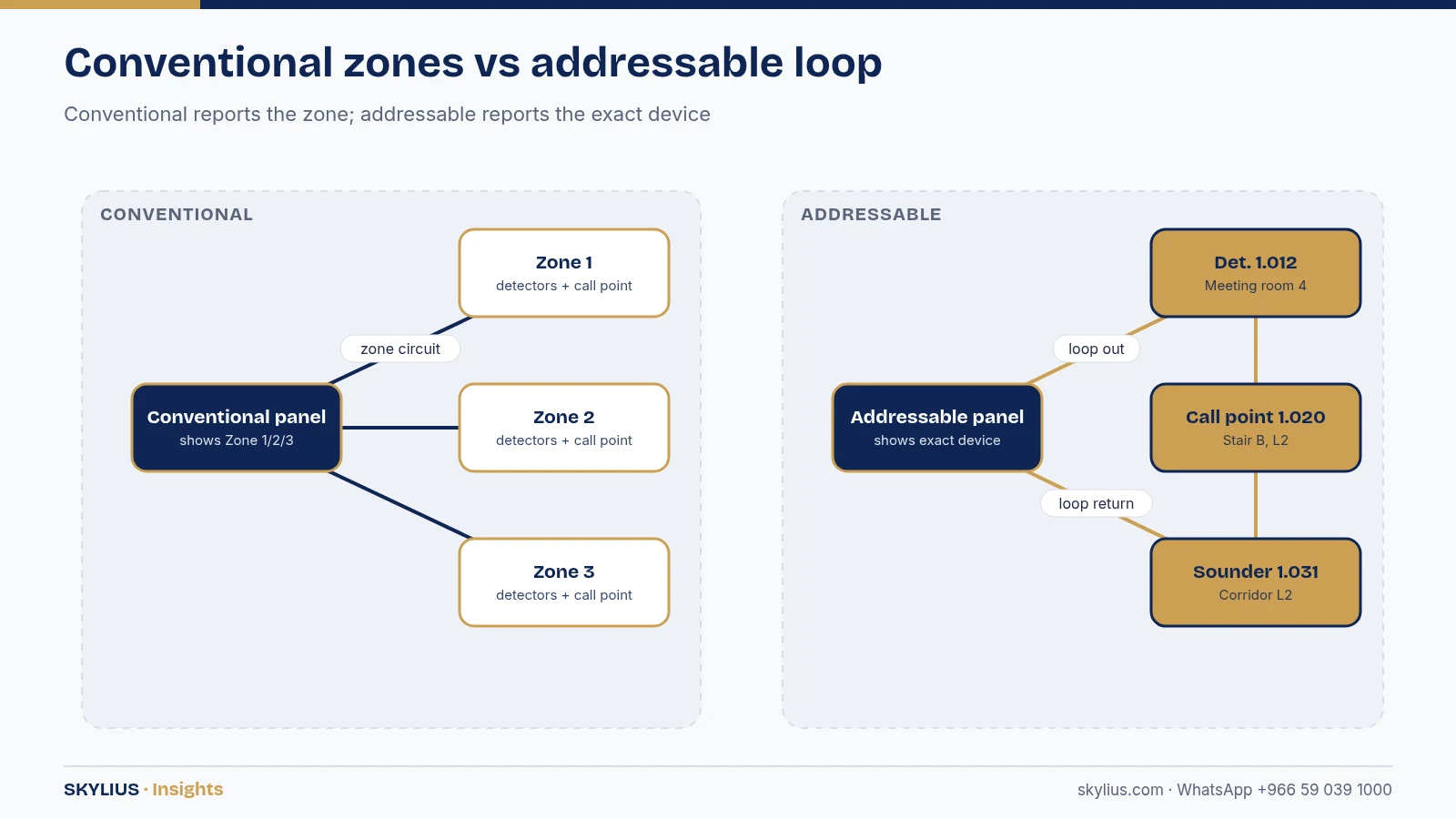
Detectors and call points are wired onto zone circuits. Each zone typically covers one floor or one area. When a device activates, the panel shows “Fire – Zone 3”, for example, and staff go to that zone to find the source.
Strengths
- Simple, well-understood technology.
- Lower equipment cost per device in many cases.
- Easy to operate for small buildings with few rooms.
Limitations
- The panel does not show the exact device, so locating the fire takes longer in large zones.
- More cabling is usually needed because each zone runs back to the panel.
- Fault finding can be slower.
Best for
Small shops, small offices, villas and small warehouses with a simple layout.
Addressable fire alarm systems
How it works
Every detector, call point and module has a unique address on a loop (a cable that leaves the panel and returns to it). The panel can tell you “Smoke detector – 2nd floor, meeting room 4”. Many addressable panels support multiple loops, network to other panels and keep a detailed event log.
Strengths
- Exact location of alarms and faults, which speeds up response.
- Loop wiring can reduce cable compared with many separate zones, and a loop wired correctly can continue to work if it is broken at one point.
- Programmable cause-and-effect: for example, a detector in one area can trigger specific sounders, door releases or fan shutdowns.
- Better diagnostics: dirty or faulty detectors can be flagged for maintenance.
Limitations
- Higher equipment cost per device.
- Requires trained engineers to program and maintain.
Best for
Offices, hospitals and clinics, hotels, schools, malls, large warehouses, compounds and any multi-storey building.
Wireless fire alarm systems
How it works
Detectors and call points communicate with the panel (or with wired “translator” modules) by radio. Devices are battery powered, and the system monitors signal strength and battery levels.
Strengths
- Minimal cabling, so installation is faster and less disruptive.
- Useful for heritage buildings, temporary structures, occupied premises and areas where cabling is impractical.
- Easy to relocate devices when layouts change.
Limitations
- Batteries must be monitored and replaced on schedule.
- Radio coverage must be surveyed; thick concrete and metal can affect signals.
- Equipment cost per device is usually higher.
Hybrid systems
Many projects use a hybrid design: an addressable wired backbone with wireless devices in areas that are difficult to cable, such as an extension, a glass atrium or a decorated reception.
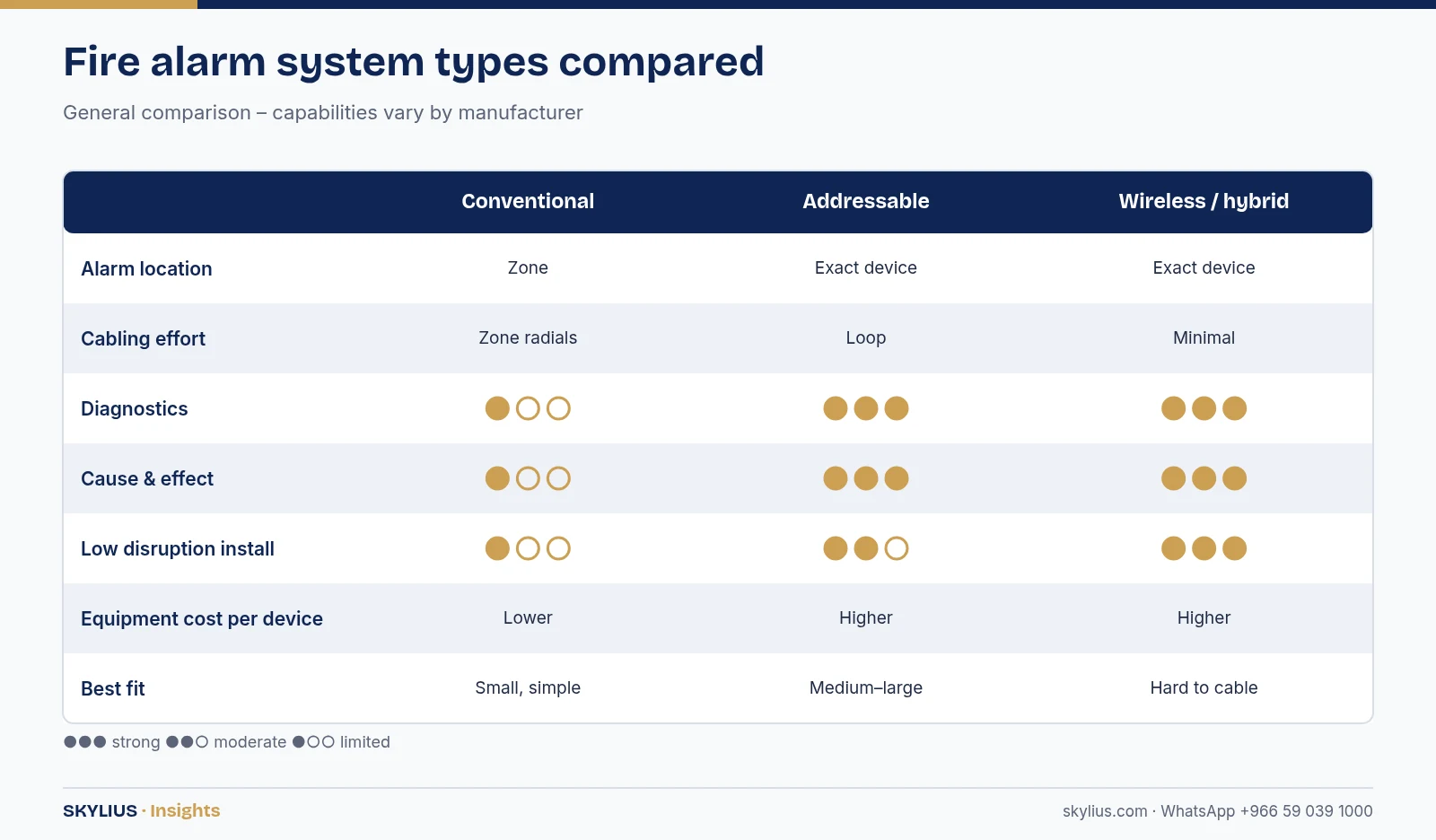
Comparison table
| Feature | Conventional | Addressable | Wireless / hybrid |
|---|---|---|---|
| Alarm location shown | Zone (area) | Exact device | Exact device |
| Cabling | Radial zone circuits | Loop cabling | Minimal detector cabling |
| Typical building size | Small, simple | Medium to large | Any, especially hard-to-cable |
| Equipment cost per device | Lower | Higher | Higher |
| Installation disruption | Medium | Medium | Low |
| Diagnostics and logs | Basic | Detailed | Detailed + battery/signal |
| Cause-and-effect programming | Limited | Extensive | Extensive |
| Ongoing maintenance | Standard | Standard | Standard + battery replacement |
General comparison; actual capabilities depend on the manufacturer and model.
Choosing detectors: smoke, heat and multi-sensor
The panel type is only half the story. Each room needs the right detector:
- Optical smoke detectors – the common choice for offices, corridors and bedrooms.
- Heat detectors – used where smoke detectors would cause false alarms, such as kitchens, some plant rooms and dusty areas.
- Multi-sensor detectors – combine smoke and heat sensing to improve reliability.
- Beam detectors – cover high, open spaces such as warehouses and halls.
- Aspirating detectors – draw air through pipes for very early detection, often in server rooms or high-value areas.
- Manual call points – placed on escape routes so people can raise the alarm.
Dust, humidity and heat in some Saudi industrial sites can increase false alarms if the wrong detector is used. A good designer chooses detector type room by room.
Recommendations by building type
Villa or small apartment building
A small conventional or wireless system is often sufficient, with smoke detectors in living areas and corridors, heat detectors in kitchens and a sounder audible throughout. Check whether your building type has specific requirements.
Office or clinic
Addressable is usually the better choice: exact alarm location, integration with access control to release doors, and detailed logs for inspections. Clinics and hospitals may also need specific evacuation strategies – confirm with the authority.
Warehouse or factory
Addressable panels with beam or aspirating detection for high ceilings, heat detectors in dusty or hot zones, and interfaces to shut down ventilation where required.
Retail, mall or hotel
Addressable networked panels, voice evacuation where required, and careful cause-and-effect programming across floors and tenancies.
Saudi requirements: what to keep in mind
In Saudi Arabia, fire protection systems are regulated. The applicable building code and the General Directorate of Civil Defense set requirements that can cover system design, approved equipment, contractor qualifications, testing, inspection and maintenance. These requirements differ by building type and are updated over time. Always confirm the current requirements with Civil Defense or the official building-code authority before design and installation, and keep records of testing and maintenance. Skylius can explain what typically applies, but the official source always prevails.
Maintenance: keeping the system reliable
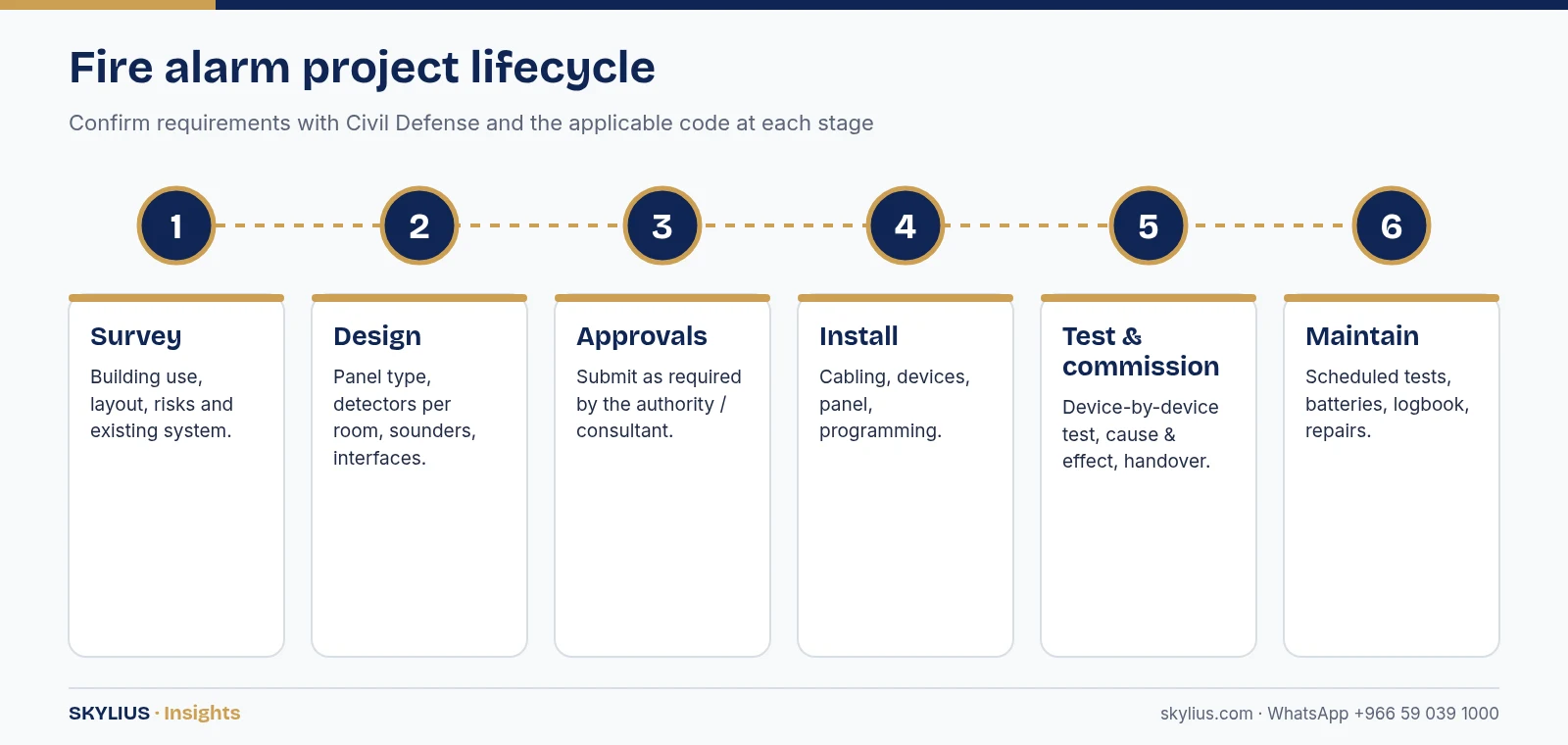
A fire alarm only protects you if it works. A typical maintenance programme includes:
- Regular visual checks of the panel for faults.
- Periodic testing of detectors, call points and sounders.
- Battery checks and replacement.
- Cleaning or replacing contaminated detectors.
- Keeping a logbook of tests, faults and actions.
Your contractor should recommend a schedule based on the applicable code and the manufacturer’s guidance. See our IT and systems maintenance contract checklist for what a good contract covers.
How Skylius helps
Skylius Holding designs, supplies, installs, tests and maintains conventional, addressable and wireless fire alarm systems for offices, clinics, warehouses, compounds and villas across the Eastern Province. We coordinate with your consultant and help you prepare for inspections, and we can integrate fire alarm outputs with access control, CCTV and building systems.
Talk to our fire alarm team: visit our fire alarm service or message us on WhatsApp +966 59 039 1000.
Frequently asked questions
What is the difference between conventional and addressable fire alarms?
A conventional system reports alarms by zone, so you know which area is affected. An addressable system identifies the exact device that triggered, which speeds up response and fault finding.
Is an addressable fire alarm system worth the extra cost?
For medium and large buildings it usually is, because exact alarm location, better diagnostics and programmable cause-and-effect improve safety and maintenance. For very small, simple buildings a conventional system can be adequate.
Are wireless fire alarm systems reliable?
Quality wireless systems monitor signal strength and battery levels and report faults to the panel. They need a proper radio survey and scheduled battery replacement.
Which detector should be used in a kitchen?
Heat detectors are commonly used in kitchens because cooking can trigger smoke detectors. Your designer should confirm the right detector for each room.
Can a fire alarm system unlock doors automatically?
Yes, fire alarm panels can provide outputs to release access-controlled doors on escape routes, subject to the approved design and applicable requirements.
How often should a fire alarm system be tested?
Testing frequency is set by the applicable code and manufacturer guidance. Ask your contractor for a maintenance schedule and keep a logbook of all tests.
Do I need Civil Defense approval for a fire alarm system?
Many buildings in Saudi Arabia require fire protection systems that meet Civil Defense requirements. Check the current rules for your building type with the official authority.
Can I upgrade a conventional system to addressable?
Often yes, sometimes reusing parts of the cabling after testing. A survey will show whether a full or phased upgrade makes sense.