
Types of CCTV Cameras: A Practical Guide for Saudi Businesses and Homes (2026)
Quick answer
The main CCTV camera types are dome, bullet, turret (eyeball), PTZ, fisheye (360°), box, and specialty cameras such as ANPR (licence-plate recognition) and thermal cameras. Most systems today are IP cameras recording to an NVR. For most Saudi offices and shops, turret or dome IP cameras indoors and bullet or turret cameras outdoors cover the majority of needs. Warehouses and compounds often add PTZ cameras for wide areas and ANPR cameras at gates. In the Saudi climate, choose outdoor cameras with a suitable IP66/IP67 weather rating, a wide operating temperature range, and good low-light performance. Requirements for some facilities are set by Saudi authorities, so always confirm the current rules for your sector before you install.
Why camera type matters
Picking the “wrong” camera is one of the most common reasons a CCTV system disappoints. A camera that looks fine in a brochure may give you a face you cannot recognise, a plate you cannot read, or an image washed out by midday sun. The type of camera decides:
- Field of view – how much area one camera covers.
- Level of detail – whether you can detect, observe, recognise or identify a person or vehicle at a given distance.
- Durability – resistance to heat, dust, humidity and tampering.
- Cost of the whole system – fewer well-chosen cameras often beat many poorly placed ones.
This guide explains each type in plain language, compares them side by side, and then recommends setups for homes, villa compounds, warehouses, offices and retail stores in Saudi Arabia.
Analog vs IP cameras: the first decision
Before choosing a shape, decide on the technology.
Analog (HD-over-coax) cameras
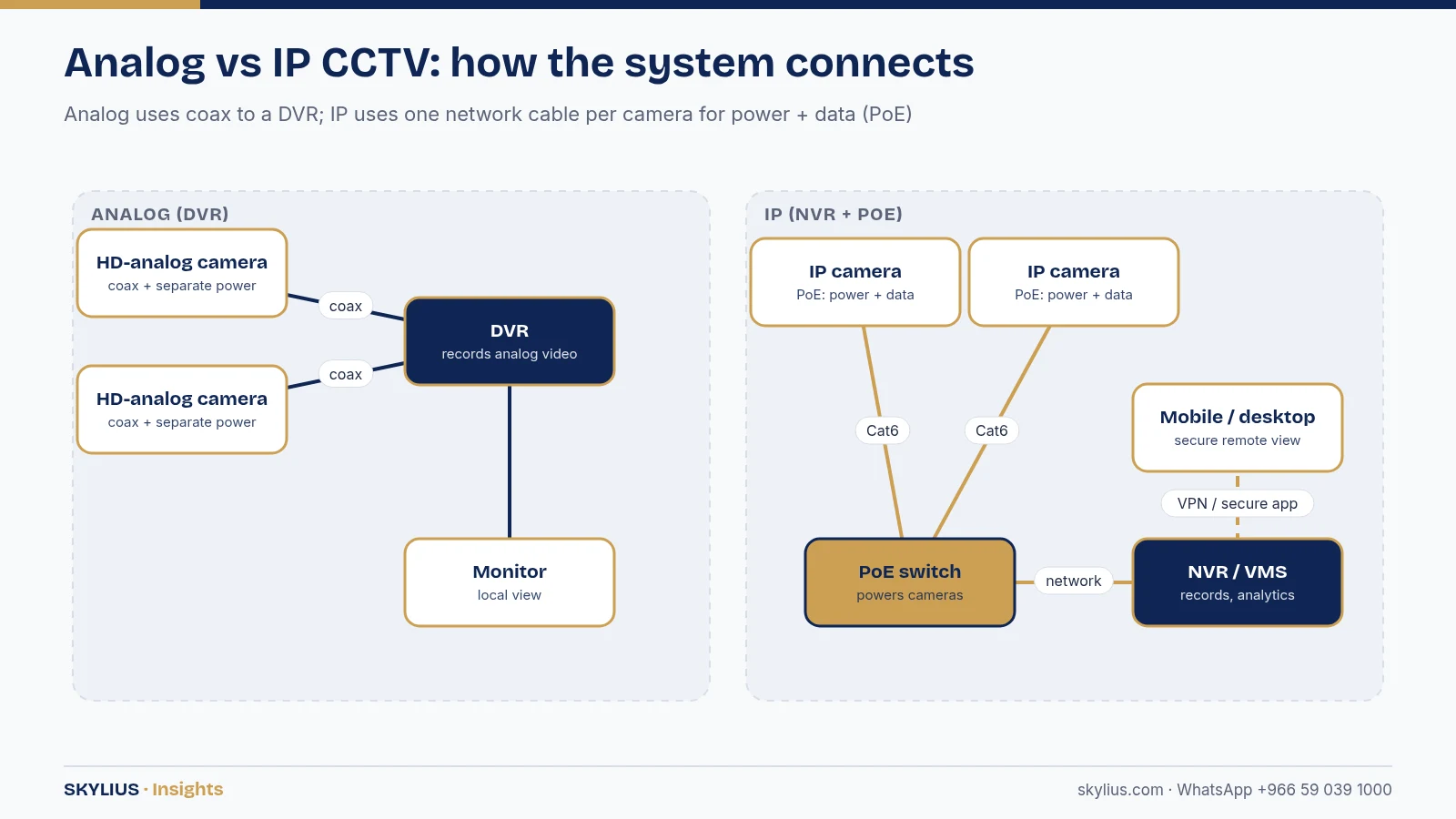
Analog cameras send video over coaxial cable to a DVR (digital video recorder). Modern HD-analog formats deliver much better images than older systems, and they can reuse existing coax cabling. They are a reasonable option when you are upgrading an older site on a tight budget, but they offer fewer smart features and less flexibility.
IP (network) cameras
IP cameras send digital video over a network cable to an NVR (network video recorder) or a video management system. Most use PoE (Power over Ethernet), so one cable carries both power and data. IP cameras generally offer higher resolutions, better analytics (line crossing, intrusion detection, people counting), easier remote viewing, and easier expansion. For new installations in offices, warehouses, compounds and retail, IP is usually the recommended choice.
Tip: An IP system is only as good as the network beneath it. Structured cabling, correctly sized PoE switches and network security are part of the CCTV project, not extras.
The main CCTV camera types explained
1. Dome cameras
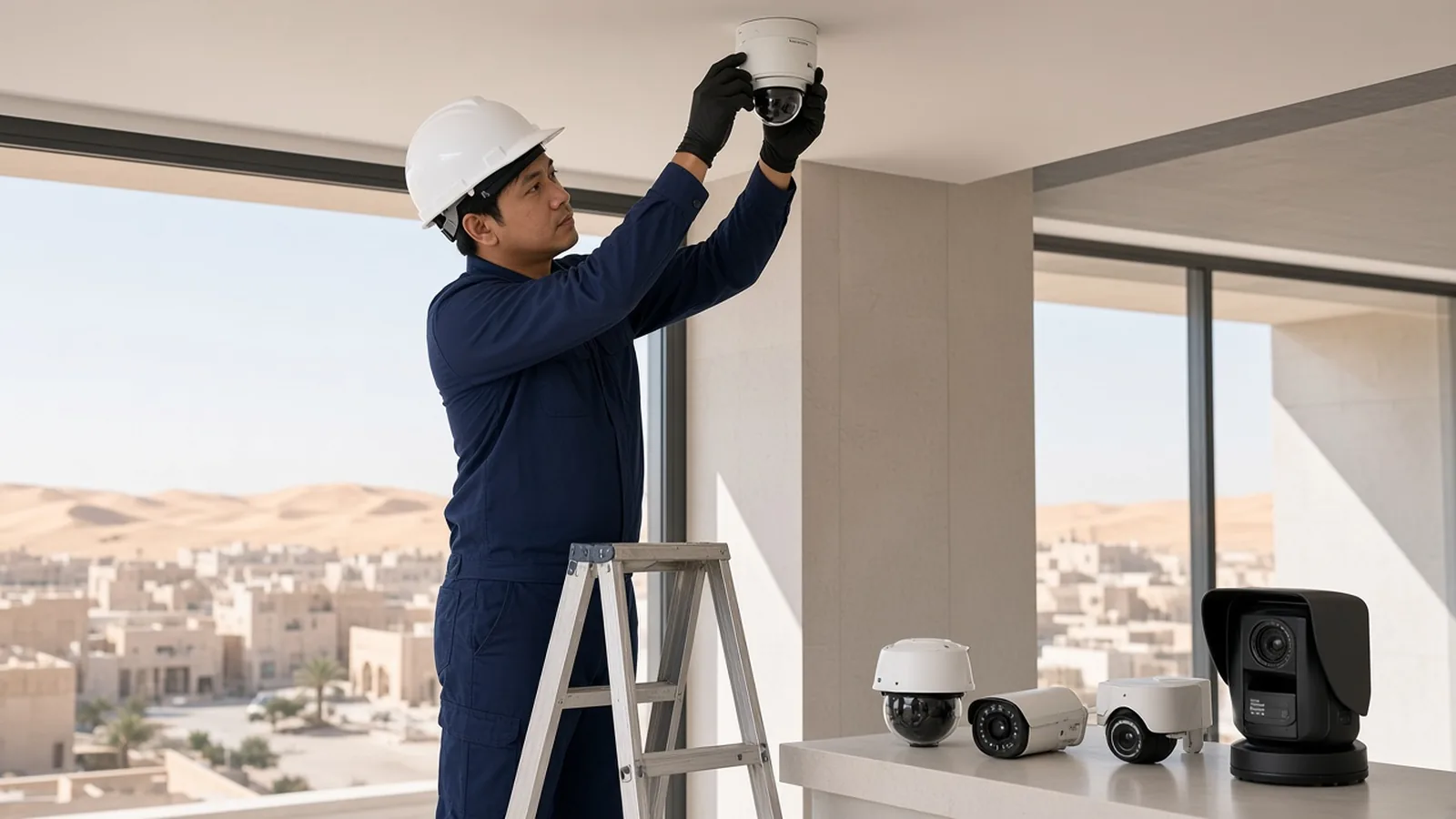
Dome cameras sit inside a rounded, often tinted cover, usually mounted on a ceiling.
- Strengths: Discreet, hard to tell which way they are pointing, vandal-resistant (IK10-rated models are available), good for indoor spaces.
- Weaknesses: The dome cover can cause reflections or glare with infrared at night; dust on the dome shows in the image.
- Best for: Offices, reception areas, corridors, retail floors, clinics.
2. Bullet cameras
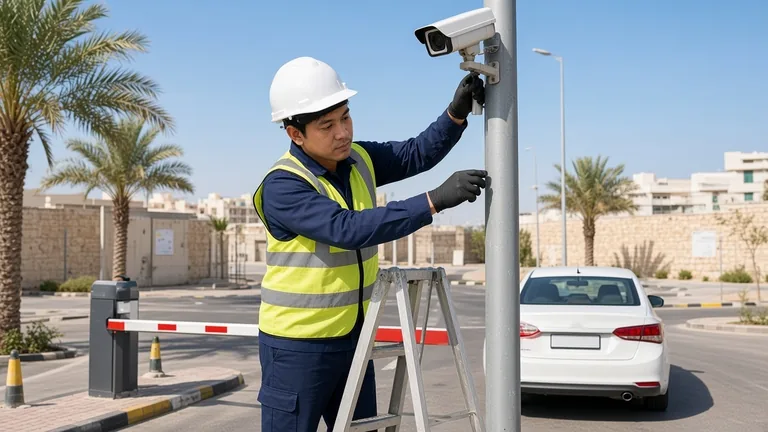
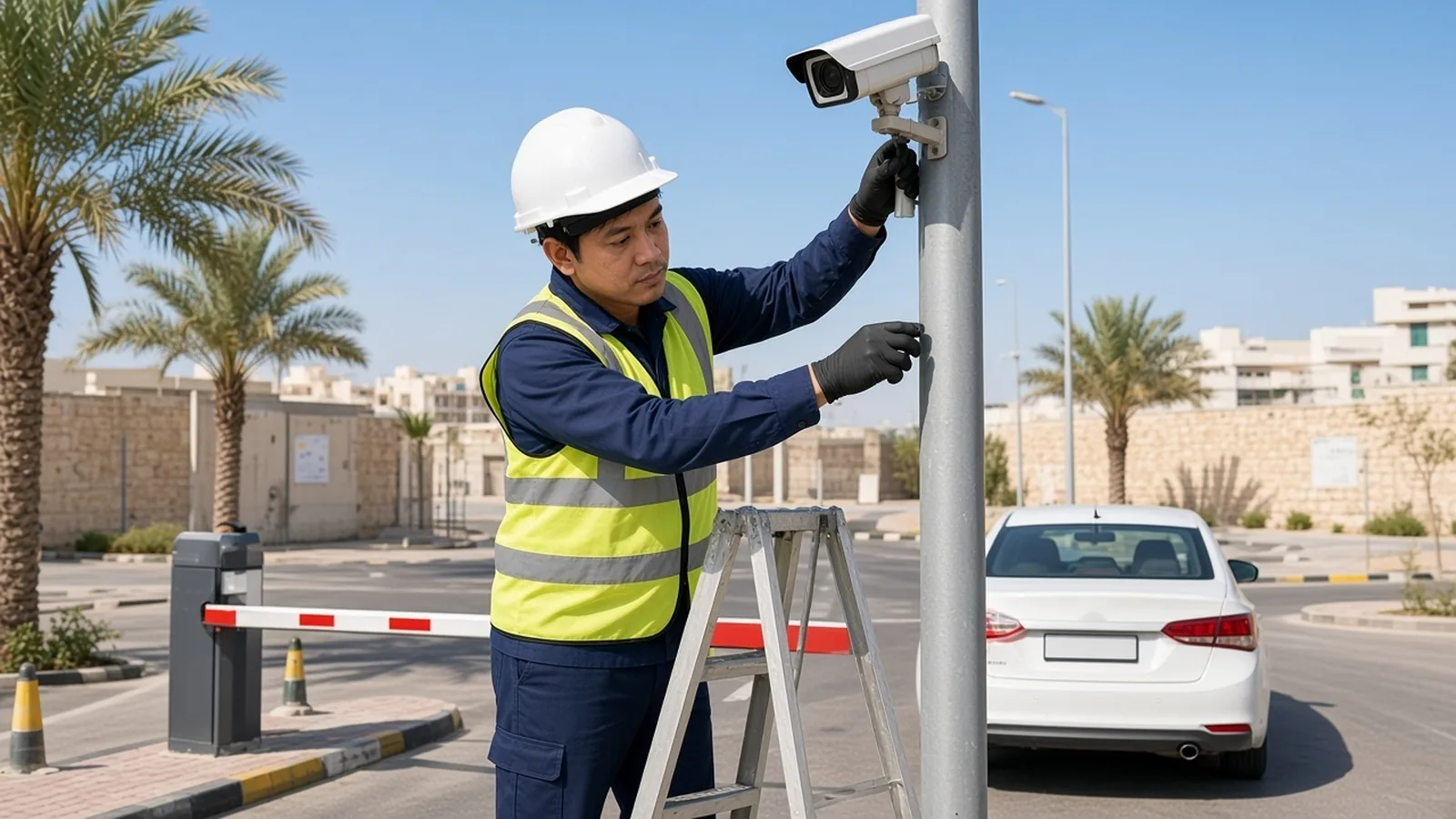
Bullet cameras are cylindrical and mounted on a wall or pole.
- Strengths: Very visible (a deterrent), often have longer infrared range and longer lenses, easy to aim at a specific area such as a gate or fence line.
- Weaknesses: Easier to knock or redirect; birds and dust can be an issue outdoors.
- Best for: Perimeters, parking areas, building exteriors, long driveways.
3. Turret (eyeball) cameras
Turret cameras have a ball-shaped lens in a socket, without a covering dome.
- Strengths: No dome glare at night, easy to adjust, compact, work well indoors and outdoors. A popular all-round choice.
- Weaknesses: Slightly less vandal-resistant than a hardened dome.
- Best for: Entrances, villa exteriors, offices, shops – a strong default choice.
4. PTZ (pan-tilt-zoom) cameras
PTZ cameras can rotate, tilt and optically zoom, either controlled by an operator or following preset tours. Some can auto-track moving objects.
- Strengths: One camera can cover a very large area and zoom in for detail.
- Weaknesses: Higher cost; when it looks one way, it is not watching the other. Best used alongside fixed cameras, not instead of them.
- Best for: Large yards, warehouses, compounds, car parks, sites with a monitoring room.
5. Fisheye (360°) cameras
Fisheye cameras use an ultra-wide lens to capture a full 360° view from a single ceiling point, which software can “de-warp” into normal views.
- Strengths: Covers an entire room with one camera; no blind spots under the camera.
- Weaknesses: Less detail at the edges; not ideal for identifying faces at distance.
- Best for: Open-plan offices, shop floors, lobbies, warehouse aisle intersections.
6. Box cameras
Box cameras are the classic rectangular body with an interchangeable lens, often in a separate housing.
- Strengths: Flexible lens choice for special distances or lighting.
- Weaknesses: Bulkier, more components to install.
- Best for: Specialist applications, long-distance views, custom projects.
7. ANPR / LPR (licence-plate recognition) cameras
ANPR cameras are tuned to read vehicle plates, using fast shutter speeds and infrared to capture plates on moving cars, day and night. Combined with software, they can log vehicles, open barriers for authorised plates, and alert on unknown ones.
- Strengths: Automated gate control and vehicle logs.
- Weaknesses: Must be installed at the correct angle, height and distance; plate formats and lighting matter.
- Best for: Compound gates, company car parks, warehouses, logistics yards. See our ANPR camera service.
8. Thermal cameras
Thermal cameras detect heat rather than visible light.
- Strengths: Detect people and vehicles in total darkness, smoke or dust; useful for long perimeters.
- Weaknesses: Do not show faces or plates; higher cost.
- Best for: Industrial perimeters, critical infrastructure, large open land.
Also worth knowing: low-light and “colour at night” cameras
Many manufacturers offer cameras with large sensors and supplementary warm light that show colour images at night. These help identify vehicle colours and clothing, which plain infrared (black-and-white) cannot. They are increasingly popular for villas and car parks.
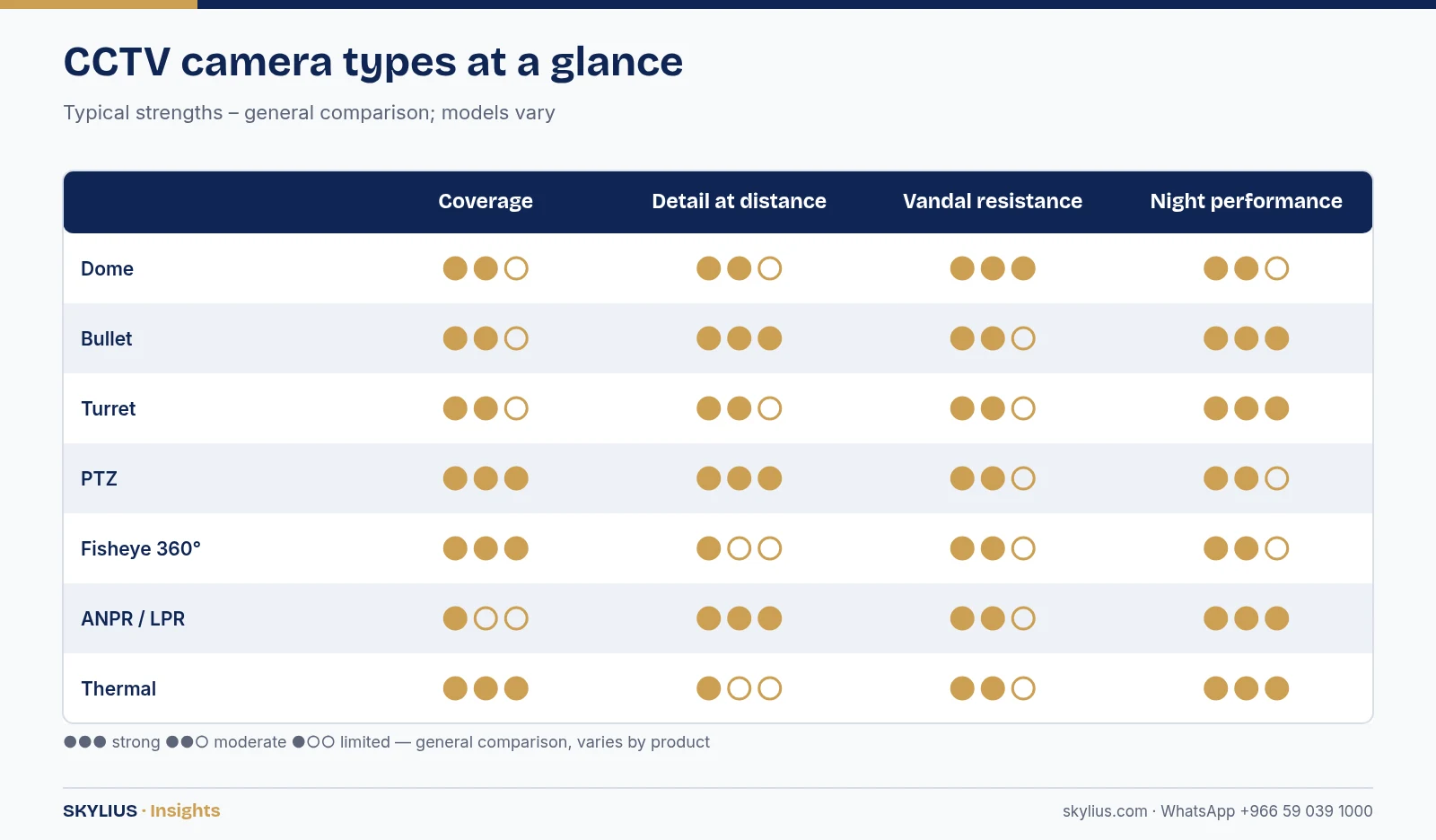
Comparison table
| Camera type | Typical location | Coverage | Detail at distance | Vandal resistance | Relative cost | Best use |
|---|---|---|---|---|---|---|
| Dome | Indoor ceilings | Medium | Medium | High (IK-rated) | Low–Medium | Offices, retail, corridors |
| Bullet | Outdoor walls/poles | Narrow–Medium | High (long lens) | Medium | Low–Medium | Perimeters, parking, gates |
| Turret | Indoor/outdoor | Medium | Medium–High | Medium | Low–Medium | All-round default |
| PTZ | High poles, corners | Very wide (moving) | Very high (zoom) | Medium | High | Yards, compounds, warehouses |
| Fisheye 360° | Indoor ceilings | Full room | Low at edges | Medium–High | Medium | Open spaces, shop floors |
| Box | Special mounts | Depends on lens | Depends on lens | Depends on housing | Medium–High | Custom/specialist |
| ANPR / LPR | Gates, barriers | Narrow (lane) | Plate-level | Medium | Medium–High | Vehicle access control |
| Thermal | Perimeters | Long range | Detection only | Medium | High | Critical sites, darkness |
Relative cost is a general comparison only; actual prices depend on brand, resolution and project size.
Key specifications to check
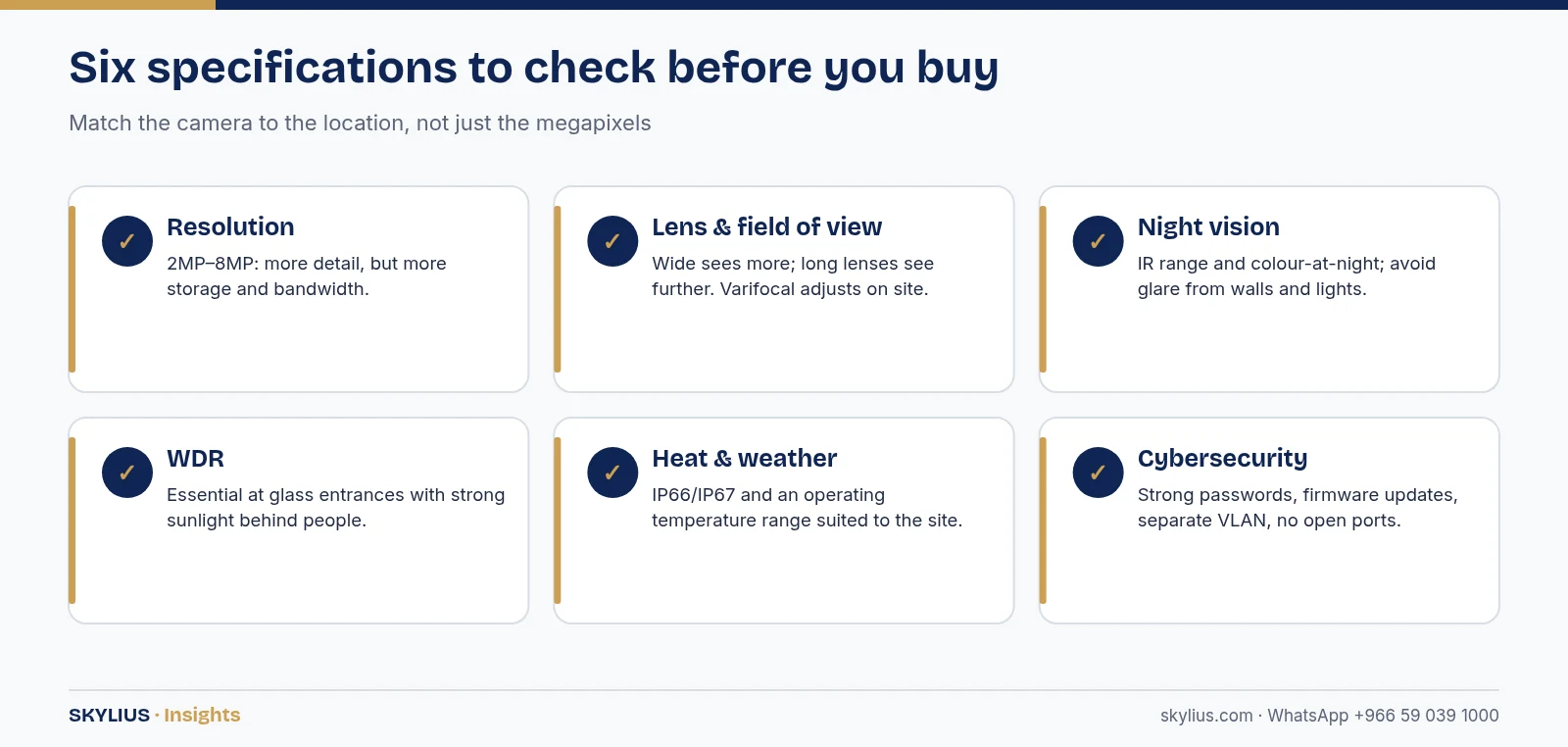
Resolution
Common resolutions are 2MP (1080p), 4MP, 5MP and 8MP (4K). Higher resolution gives more detail but needs more storage and bandwidth. Matching the right lens to the distance often matters more than the megapixel number.
Lens and field of view
Wide lenses (for example 2.8mm) see more area but less detail; longer lenses (for example 6–12mm) see further but narrower. Varifocal lenses let the installer adjust on site.
Night vision
Check the infrared range and whether the camera supports colour-at-night. Make sure lights, reflective walls or the sea front do not cause glare.
WDR (wide dynamic range)
Essential for entrances with glass doors and strong sunlight behind – very common in Saudi buildings. Without good WDR, people at the door appear as dark silhouettes.
Weather and heat rating
For outdoor cameras, look for an IP66 or IP67 ingress rating against dust and water, and check the manufacturer’s operating temperature range against local summer conditions, especially for cameras in direct sun. Sunshades and correct mounting positions help.
Storage and retention
Plan how many days of recording you need and size the NVR hard disks accordingly. Some sectors in Saudi Arabia have specific retention and coverage requirements – confirm with the relevant authority or a licensed installer.
Analytics and AI
Modern cameras can detect line crossing, intrusion, loitering and distinguish people from vehicles, cutting false alarms. Face recognition and similar features raise privacy considerations; use them only where appropriate and lawful.
Cybersecurity
Change default passwords, keep firmware updated, separate the CCTV network (VLAN), and avoid exposing recorders directly to the internet. Saudi organisations should also consider guidance from the National Cybersecurity Authority (NCA) where applicable. Our cybersecurity team can help.
Recommendations by use case
Home or apartment
- Setup: 2–4 turret cameras (entrance, parking, back door) plus one indoor camera if needed.
- Why: Turrets avoid night glare and are easy to aim.
- Extras: A video intercom at the door and mobile app viewing.
Villa compound
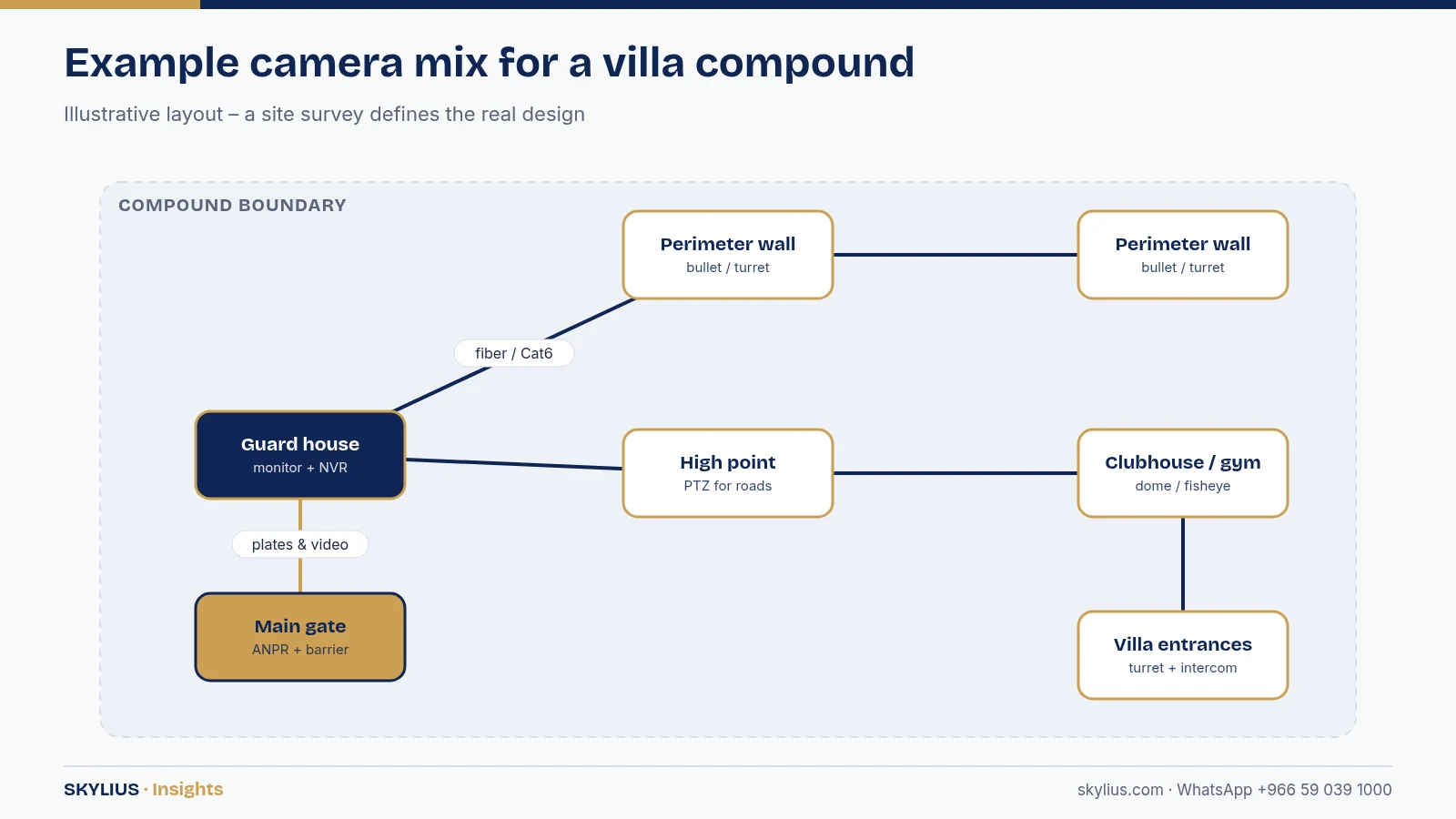
- Setup: Bullet or turret cameras along the perimeter wall, ANPR camera at the main gate, a PTZ on a high point covering internal roads, and dome cameras in shared facilities (gym, pool area, reception).
- Why: Gate logging and perimeter coverage are the priorities.
- Extras: Integrate with access control and barriers; consider colour-at-night cameras for roads.
Warehouse or logistics yard
- Setup: Bullet cameras on loading docks, fisheye cameras at aisle intersections, PTZ cameras on the yard, ANPR at vehicle entrances, and optionally thermal cameras on long fences.
- Why: Large spaces need wide coverage plus the ability to zoom on incidents.
- Extras: Strong Wi-Fi/network backbone and enough storage for high camera counts.
Office
- Setup: Turret or dome cameras at entrances and reception (with good WDR), domes in corridors, fisheye in open-plan areas, and cameras in server/IT rooms.
- Why: Discreet, professional look while covering access points.
- Extras: Link with access control and visitor management.
Retail store or showroom
- Setup: Domes or fisheyes on the shop floor, a high-resolution camera on cash counters, turret at the entrance, and bullets for the car park or rear stockroom door.
- Why: Cover customer areas, transactions and back-of-house losses.
- Extras: People-counting analytics to understand peak hours.
Saudi regulations: what to keep in mind
Certain facility types in Saudi Arabia are subject to security surveillance requirements, and authorities may specify aspects such as coverage, recording retention, and the use of approved or licensed contractors. These requirements change over time and differ by sector. Before you buy, check the latest requirements from the relevant authority (for example, through official government portals or your municipality/sector regulator), and work with a qualified installer who can advise on compliance. Skylius can help you understand what applies to your site, but the official source always prevails.
How Skylius helps
Skylius Holding designs, supplies, installs and maintains CCTV systems for homes, compounds, offices, warehouses and retail across Al Khobar, Dammam and the wider Kingdom. We handle the full chain: site survey, camera selection, structured cabling, network and NVR setup, ANPR and access control integration, and ongoing maintenance contracts.
Get a free site assessment: visit our CCTV installation service or message us on WhatsApp +966 59 039 1000.
Frequently asked questions
What is the best type of CCTV camera for a business?
There is no single best type. Most businesses use a mix: turret or dome IP cameras indoors, bullet or turret cameras outdoors, and PTZ or ANPR cameras where wide areas or vehicles need monitoring. A site survey determines the right mix.
Are IP cameras better than analog cameras?
For new installations, IP cameras usually offer higher resolution, smarter analytics and easier expansion. Analog HD cameras can still make sense when upgrading an older system that already has coaxial cabling.
What is the difference between dome and bullet cameras?
Dome cameras are compact, discreet and ceiling-mounted, ideal indoors. Bullet cameras are cylindrical, more visible and usually have longer range, making them better for outdoor perimeters and parking areas.
Which cameras work best in Saudi heat?
Choose outdoor cameras with an IP66 or IP67 rating and an operating temperature range suitable for local summer conditions, mount them away from direct afternoon sun where possible, and use sunshades. Check the manufacturer’s datasheet for each model.
What is an ANPR camera and do I need one?
An ANPR (automatic number plate recognition) camera reads vehicle licence plates. It is useful for compounds, company car parks and warehouses that need automatic gate control or vehicle logs.
How many days of CCTV recording should I keep?
It depends on your needs and sector. Some facilities in Saudi Arabia have specific retention requirements set by authorities, so confirm the current rules for your sector and size storage accordingly.
Can I view my CCTV cameras on my phone?
Yes. Most modern NVRs and IP cameras support secure mobile viewing. It should be configured with strong passwords, updated firmware and secure remote access rather than open ports.
How much does a CCTV system cost in Saudi Arabia?
Cost depends on the number and type of cameras, resolution, storage, cabling and integration. The most reliable way to get an accurate price is a site survey and itemised quotation.