
Access Control Systems: Card vs Fingerprint vs Face vs Mobile
Quick answer
The main access control credential types are PIN codes, proximity or smart cards, fingerprint (biometric), face recognition and mobile credentials on a smartphone. Cards are economical and fast but can be lent or lost. Fingerprint and face readers tie access to the person, which suits sensitive rooms and time attendance. Mobile credentials are convenient and easy to issue or revoke remotely. Most businesses combine them: cards or mobile for general doors, biometrics or two-factor (card + PIN or card + face) for server rooms, cash rooms and pharmacies. Choose based on security level, number of users, traffic at the door, environment and how you will manage users. Biometric data is personal data, so handle it in line with Saudi data protection rules.
How an access control system works
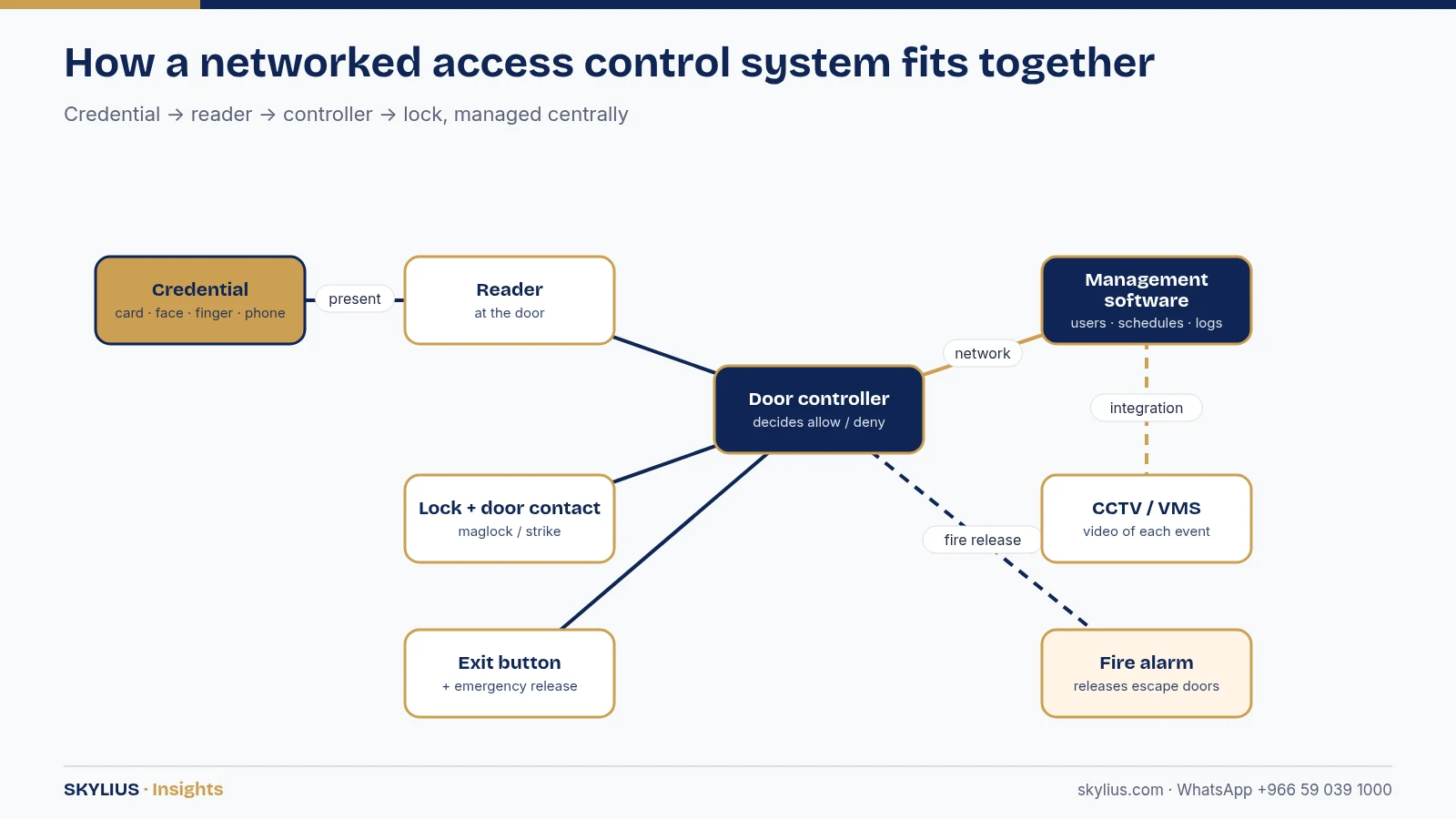
Every system has the same building blocks:
- Credential – what the user presents: a card, a code, a finger, a face or a phone.
- Reader – reads the credential at the door.
- Controller – decides whether the credential is allowed at that door at that time.
- Locking hardware – electromagnetic locks, electric strikes, motorised locks, turnstiles, barriers or speed gates.
- Door monitoring and exit devices – door contacts, request-to-exit buttons, emergency break-glass units.
- Management software – where you add users, set schedules, view events and run reports.
- Power supply with battery backup – so doors behave correctly during a power cut.
Systems can be standalone (one reader controls one door, managed at the device) or networked (many doors managed centrally, often integrated with CCTV, fire alarm and time attendance).
Credential types explained
PIN / keypad
- Strengths: No card to carry; low cost.
- Weaknesses: Codes get shared and observed; slow at busy doors.
- Best for: Low-security internal doors or as a second factor.
Proximity and smart cards / key fobs
Older proximity cards are easy to copy; modern encrypted smart cards are much harder to clone.
- Strengths: Fast, familiar, economical, easy to issue to visitors.
- Weaknesses: Cards can be lent, lost or stolen. Choose encrypted card technology rather than basic proximity.
- Best for: Main entrances, general office doors, car park barriers.
Fingerprint readers
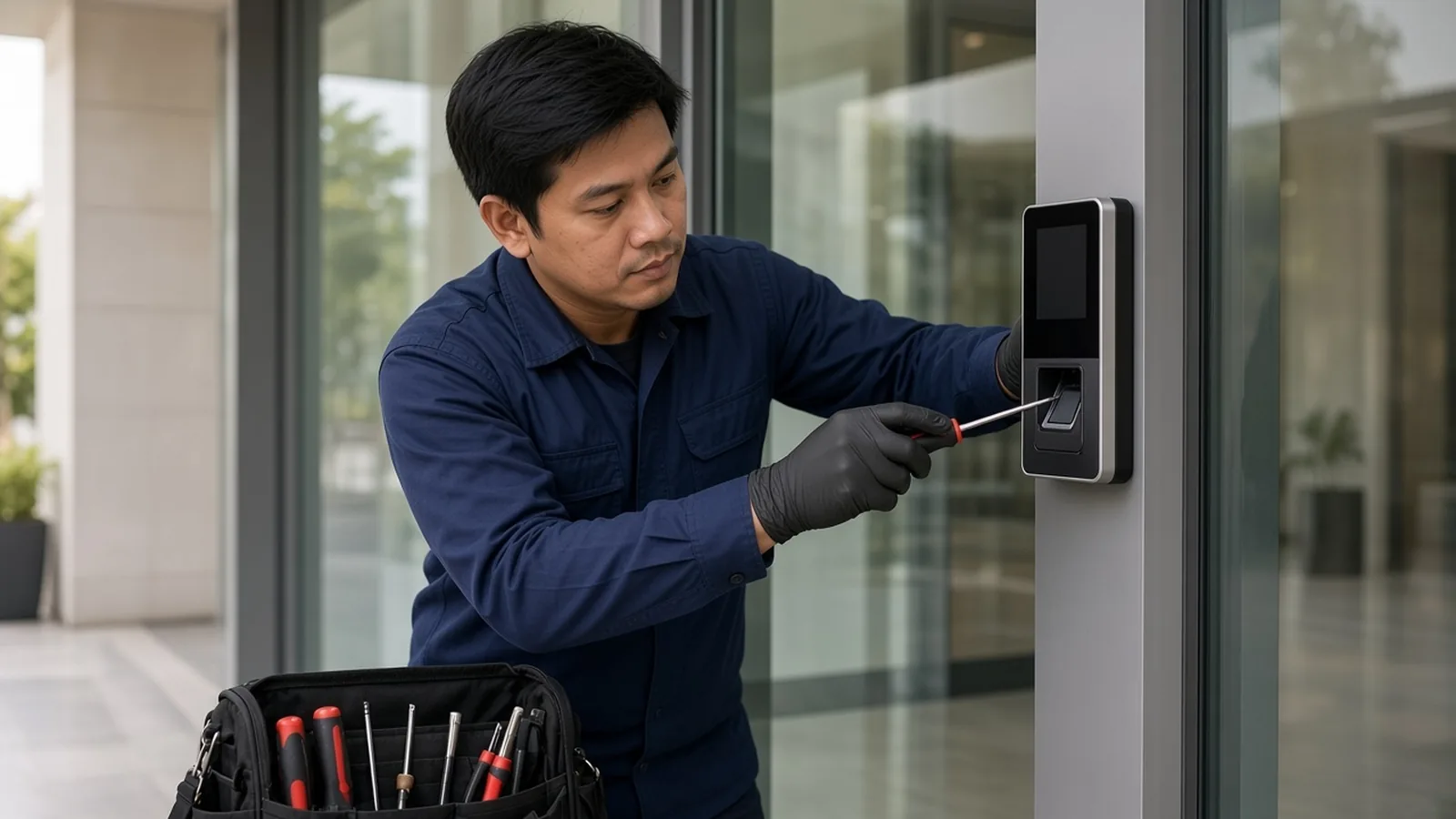
- Strengths: Credential cannot be lent; widely used for time attendance.
- Weaknesses: Dust, sweat, dry skin, gloves and wear can reduce reading reliability; contact-based.
- Best for: Server rooms, stores, offices with attendance tracking.
Face recognition readers
- Strengths: Touchless and fast; works for staff carrying items; many units combine face with card or QR.
- Weaknesses: Performance depends on lighting and camera placement; strong backlight at glass entrances needs attention; privacy considerations.
- Best for: Main staff entrances, turnstiles, clinics, sites wanting touchless access.
Mobile credentials (Bluetooth / NFC / QR)
- Strengths: Credentials issued and revoked remotely; no cards to print; useful for visitors and multi-site companies.
- Weaknesses: Depends on the user’s phone and battery; requires compatible readers and a managed app or platform.
- Best for: Modern offices, co-working spaces, residential compounds, visitor management.
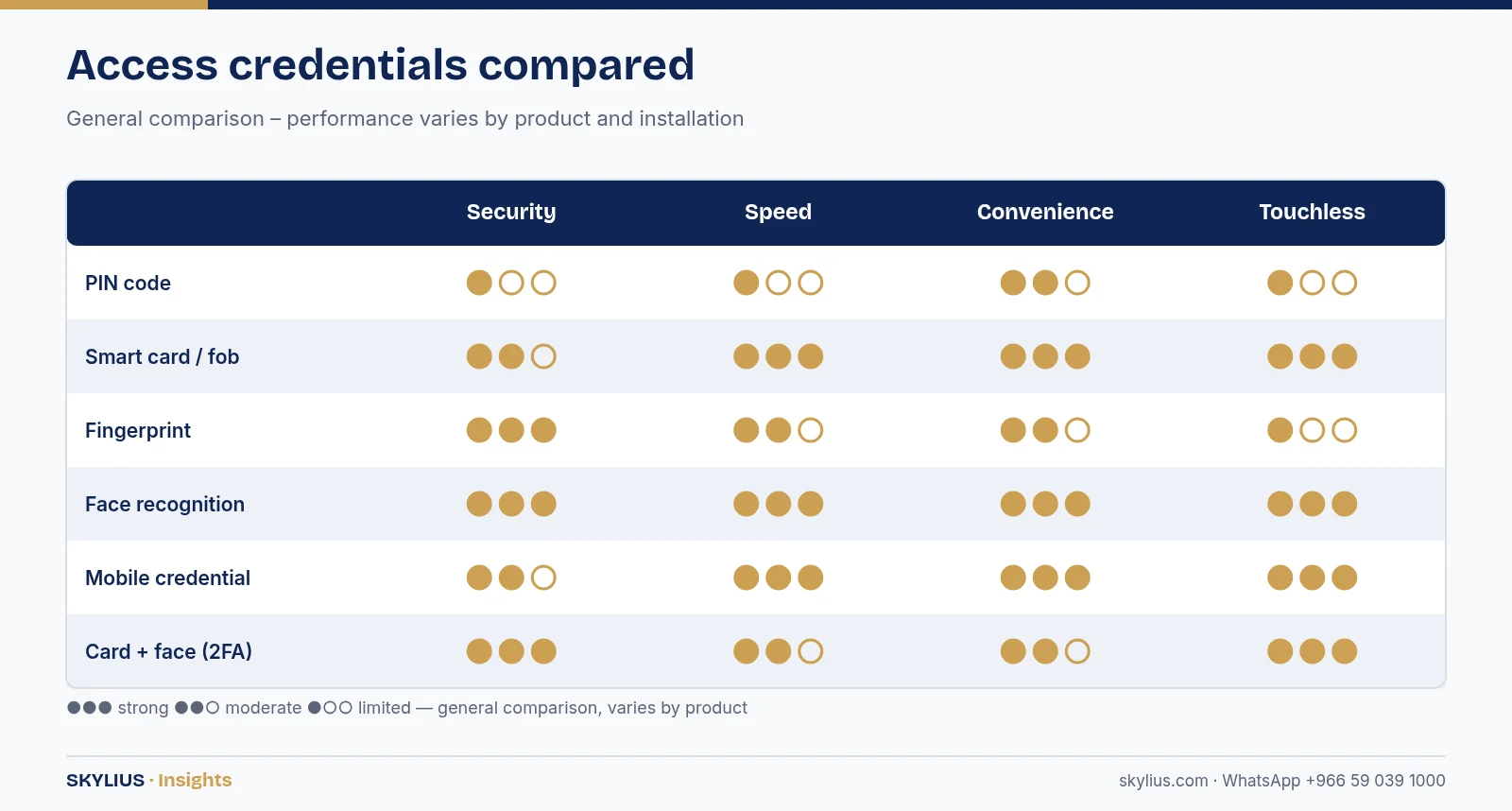
Comparison table
| Credential | Security level | Speed at door | Can be shared? | Hygiene | Relative cost | Typical use |
|---|---|---|---|---|---|---|
| PIN | Low | Slow | Yes | Contact | Low | Internal doors, second factor |
| Smart card / fob | Medium | Fast | Yes | Contactless | Low–Medium | General access, barriers |
| Fingerprint | High | Medium | No | Contact | Medium | Server rooms, attendance |
| Face recognition | High | Fast | No | Touchless | Medium–High | Staff entrances, turnstiles |
| Mobile | Medium–High | Fast | Harder | Contactless | Medium | Offices, compounds, visitors |
| Two-factor (e.g. card + face) | Very high | Medium | No | Varies | Higher | Sensitive areas |
General comparison only; performance varies by product and installation.
Doors and locks: the part people forget
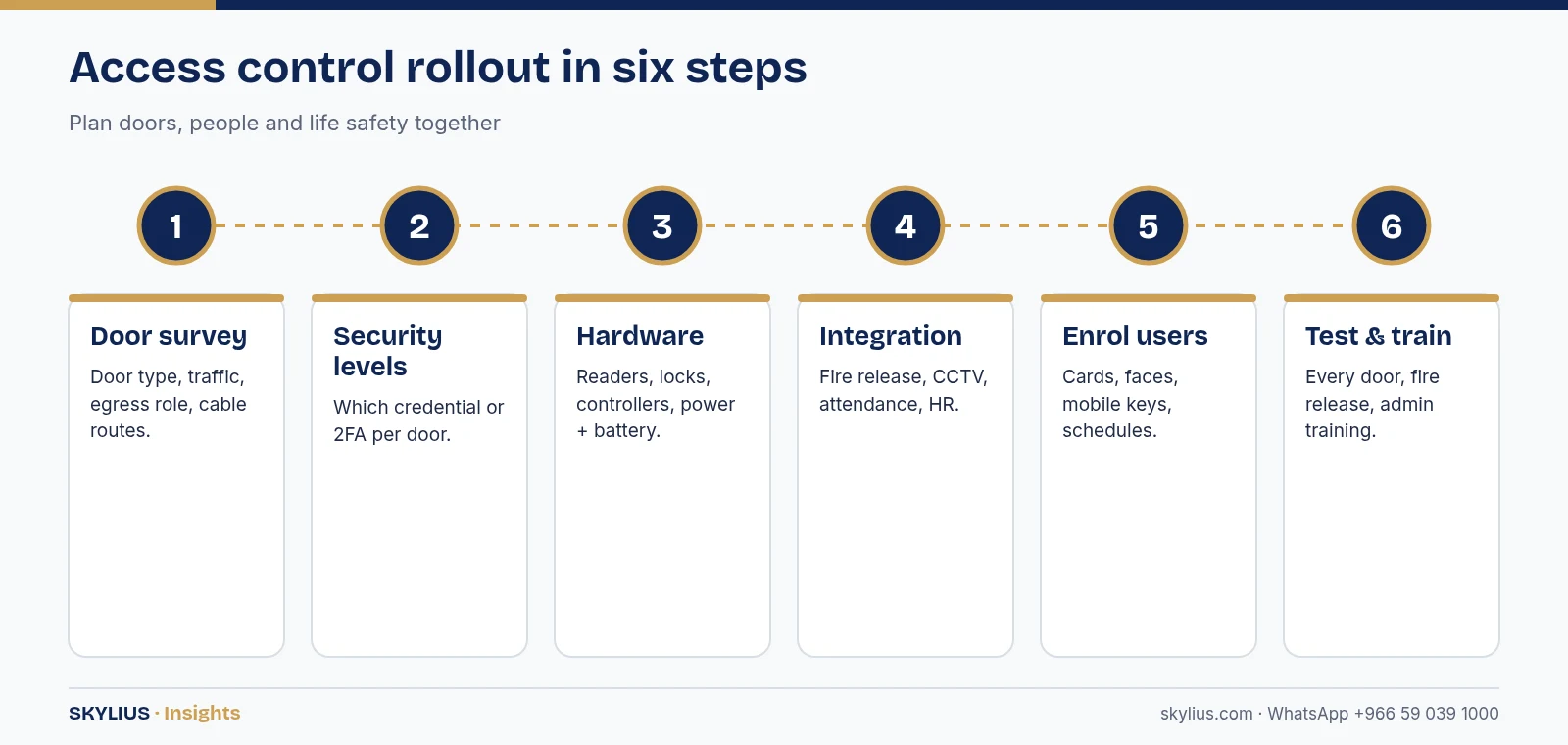
A strong credential is wasted on a weak door. Plan the hardware with the reader:
- Electromagnetic locks are common on glass and aluminium doors. They are typically fail-safe (unlock when power is removed), which supports safe exit.
- Electric strikes and motorised locks suit timber and steel doors and can be fail-safe or fail-secure depending on the door’s role.
- Turnstiles and speed gates control lobbies with high staff traffic and prevent tailgating.
- Barriers control vehicle entrances and can be combined with ANPR. See our ANPR guide.
Life safety first: doors on escape routes must allow people to leave in an emergency, and access control is usually linked to the fire alarm so that designated doors release automatically. Confirm the arrangement with the applicable fire and building requirements.
Recommendations by site
Office
Smart card or mobile credentials on main and floor doors, face or fingerprint on the server room, and integration with time attendance. Link door events with CCTV to see video of each access event.
Residential compound
Mobile or card access for pedestrian gates, ANPR plus barriers for vehicles, visitor QR codes issued by residents, and video intercom at the guard house.
Clinic or hospital
Card or face access on staff areas, two-factor for pharmacy and medicine stores, and free egress on patient escape routes in line with the fire strategy.
Warehouse or factory
Card or face on staff entrances with turnstiles, restricted zones for high-value stock, and readers suitable for dust and heat where outdoors.
Integration, data and security
Modern access control is an IT system. Treat it like one:
- Put controllers on a separate network segment and change default passwords.
- Keep firmware and software updated.
- Remove leavers promptly – ideally linked to your HR process.
- Review access rights and event logs regularly.
- Biometric templates and access logs are personal data. Handle them in line with Saudi Arabia’s Personal Data Protection Law (PDPL) and get legal advice on consent, retention and notices where needed.
Our cybersecurity checklist for SMEs covers the basics.
How Skylius helps
Skylius Holding supplies, installs and maintains access control systems – from single-door standalone readers to multi-site networked platforms with face recognition, mobile credentials, turnstiles, barriers and CCTV integration – across Al Khobar, Dammam and the Eastern Province.
Get a door-by-door proposal: visit our access control service or message us on WhatsApp +966 59 039 1000.
Frequently asked questions
Which is better: fingerprint or face recognition?
Both tie access to the person. Face recognition is touchless and faster at busy doors; fingerprint readers are often more economical and widely used for attendance. The environment and traffic level usually decide.
Are access cards secure?
Modern encrypted smart cards are much harder to copy than older proximity cards. The main risk is people lending cards, which you can reduce by adding a second factor on sensitive doors.
Can access control work with my CCTV system?
Yes. Many platforms link door events with recorded video, so you can see who entered at a given time. Integration depends on the brands used.
What happens to access-controlled doors during a power cut?
It depends on the lock type and design. Systems normally have battery backup, and escape doors are typically configured to release to allow safe exit. Confirm the design with your installer.
Can I manage access control from my phone?
Many systems offer web or mobile management to add users, open doors remotely and view events. Secure the account with strong passwords and multi-factor authentication.
Is biometric access control legal in Saudi Arabia?
Biometric systems are widely used, but biometric data is personal data. Follow the Personal Data Protection Law and seek legal guidance on consent, storage and retention.
Can access control record employee attendance?
Yes. Many readers and platforms include time-attendance features or export to payroll and HR systems.
How many doors can one controller handle?
It depends on the controller model; many support several doors each, and networked systems can scale to many controllers. Your installer will size this during design.