
ANPR Cameras Explained: How Licence-Plate Recognition Works for Gates & Car Parks
Quick answer
ANPR (automatic number plate recognition), also called LPR, uses a specialised camera and software to read vehicle licence plates and turn them into text. The system compares each plate with a list: authorised vehicles can open a barrier automatically, unknown vehicles can trigger an alert or be directed to the guard, and every entry and exit is logged with a time stamp and image. ANPR is widely used at compound gates, company car parks, warehouses, logistics yards and hospitals. Accuracy depends less on megapixels and more on correct installation: the camera angle, height, distance, shutter speed, infrared illumination and vehicle speed. A site survey for each lane is essential.
How ANPR works, step by step
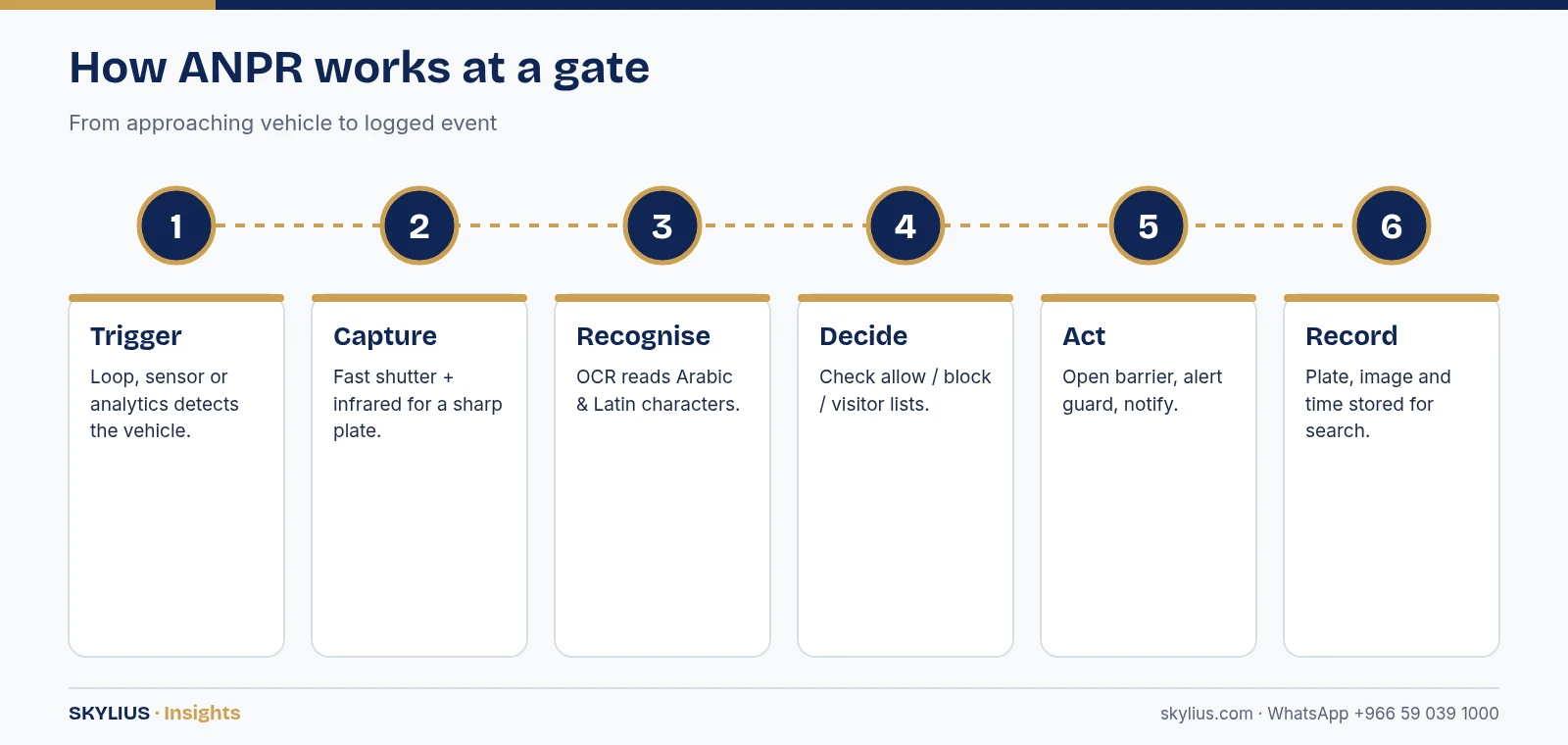
- Trigger – a vehicle approaches. The camera detects it with video analytics or a loop/sensor in the road.
- Capture – the camera takes frames with a fast shutter and infrared illumination so the plate is sharp, day and night.
- Recognition – software locates the plate in the image and reads the characters (OCR). Saudi plates include both Arabic and Latin characters, so the engine must support the local plate format.
- Decision – the plate is checked against allow lists, block lists, visitor lists or time schedules.
- Action – the controller opens a barrier, shows a message, sends a notification, or simply logs the event.
- Record – the plate text, an overview image and the time are stored for search and reports.
Camera-based vs server-based ANPR
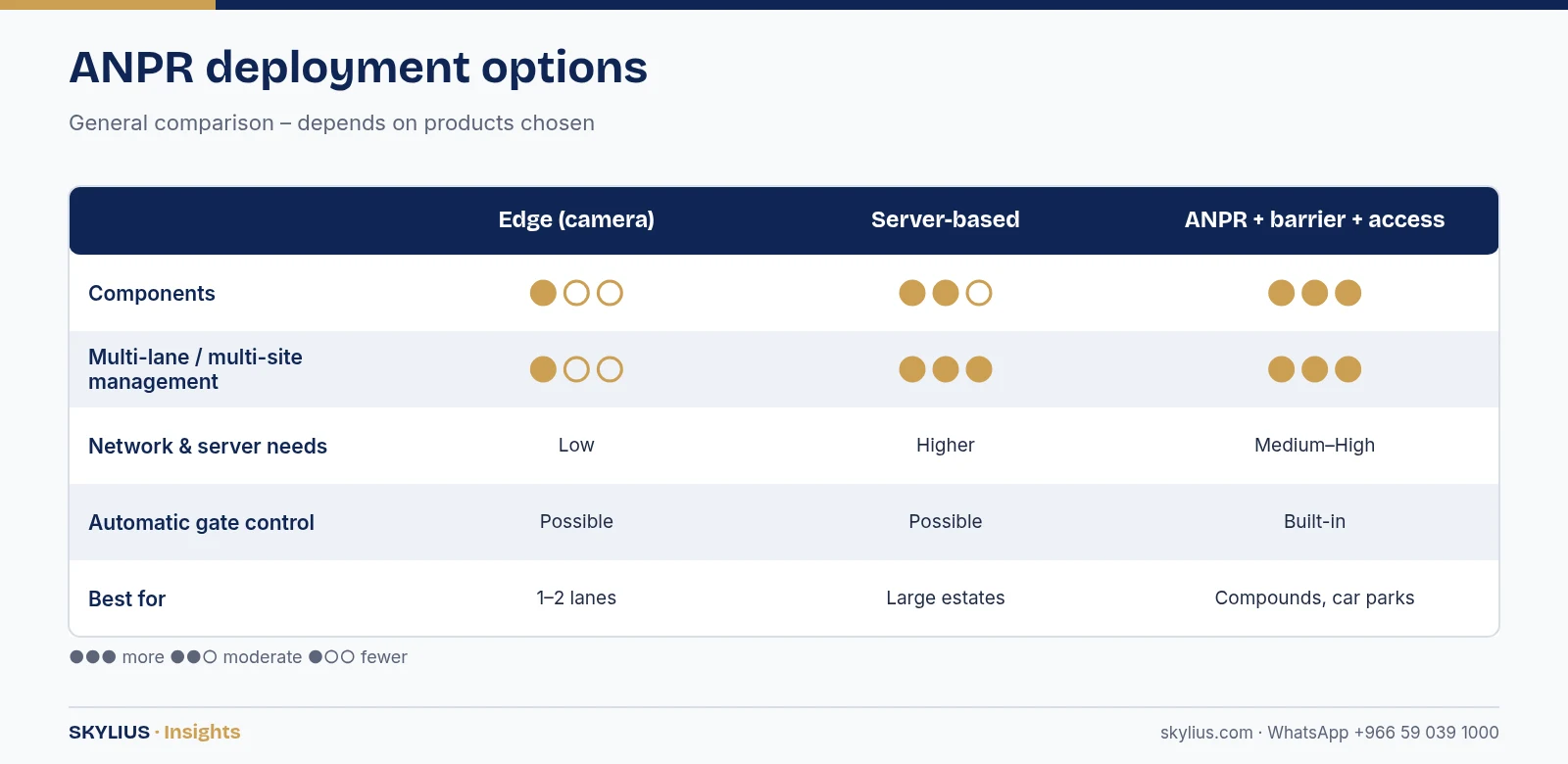
Edge (camera-based) ANPR
The recognition software runs inside the camera. The camera sends plate results directly to a controller or management platform.
- Pros: Fewer components, works well for one or two lanes, less network bandwidth.
- Cons: Processing power and features are limited to what the camera supports.
Server-based ANPR
Standard or ANPR-optimised cameras send video to a server or VMS that performs recognition.
- Pros: Central management of many lanes and sites, advanced reporting, integration with parking and access platforms.
- Cons: Needs a server, licences and a reliable network.
Many sites use edge recognition at the lane with a central platform for management and reporting.
What affects ANPR accuracy
| Factor | Why it matters | Good practice |
|---|---|---|
| Camera angle | Steep horizontal or vertical angles distort characters | Keep the angle modest; follow the manufacturer’s guidance |
| Mounting height and distance | Plate must fill enough pixels in the image | Calculate distance and lens for the plate size |
| Vehicle speed | Fast vehicles blur the image | Slow vehicles with speed bumps or barriers; use fast shutter |
| Lighting | Headlights, sun glare and darkness wash out plates | Infrared illumination and correct exposure settings |
| Plate condition | Dirty, damaged or obstructed plates are harder to read | Expect some manual handling; keep a guard fallback |
| Lane design | Vehicles at angles or two abreast confuse capture | One vehicle per lane, guide kerbs or islands |
| Plate format support | Local characters must be recognised | Choose software that supports Saudi plates |
Typical ANPR applications
Residential and villa compounds
Residents’ vehicles are added to an allow list and the barrier opens automatically. Visitors are registered in advance or handled by the guard, and all movements are logged. ANPR is often combined with access control for pedestrian gates and video intercom at the guard house.
Company car parks
Staff vehicles get automatic entry, reserved bays can be managed, and reports show occupancy patterns. The system can also be linked to HR so access is removed when staff leave.
Warehouses and logistics yards
ANPR logs trucks in and out, timestamps deliveries, and helps reconcile vehicle movements with gate passes. For trucks, plate position varies, so camera placement needs extra care.
Hospitals, hotels and commercial buildings
Combined with parking management for visitors, with automatic entry for staff and contractors.
Security and investigation
Even without a barrier, ANPR adds searchable vehicle records to your CCTV system, making it far quicker to find a vehicle in recorded footage.
Planning an ANPR installation
- Define the goal per lane – automatic barrier, logging only, or alerts.
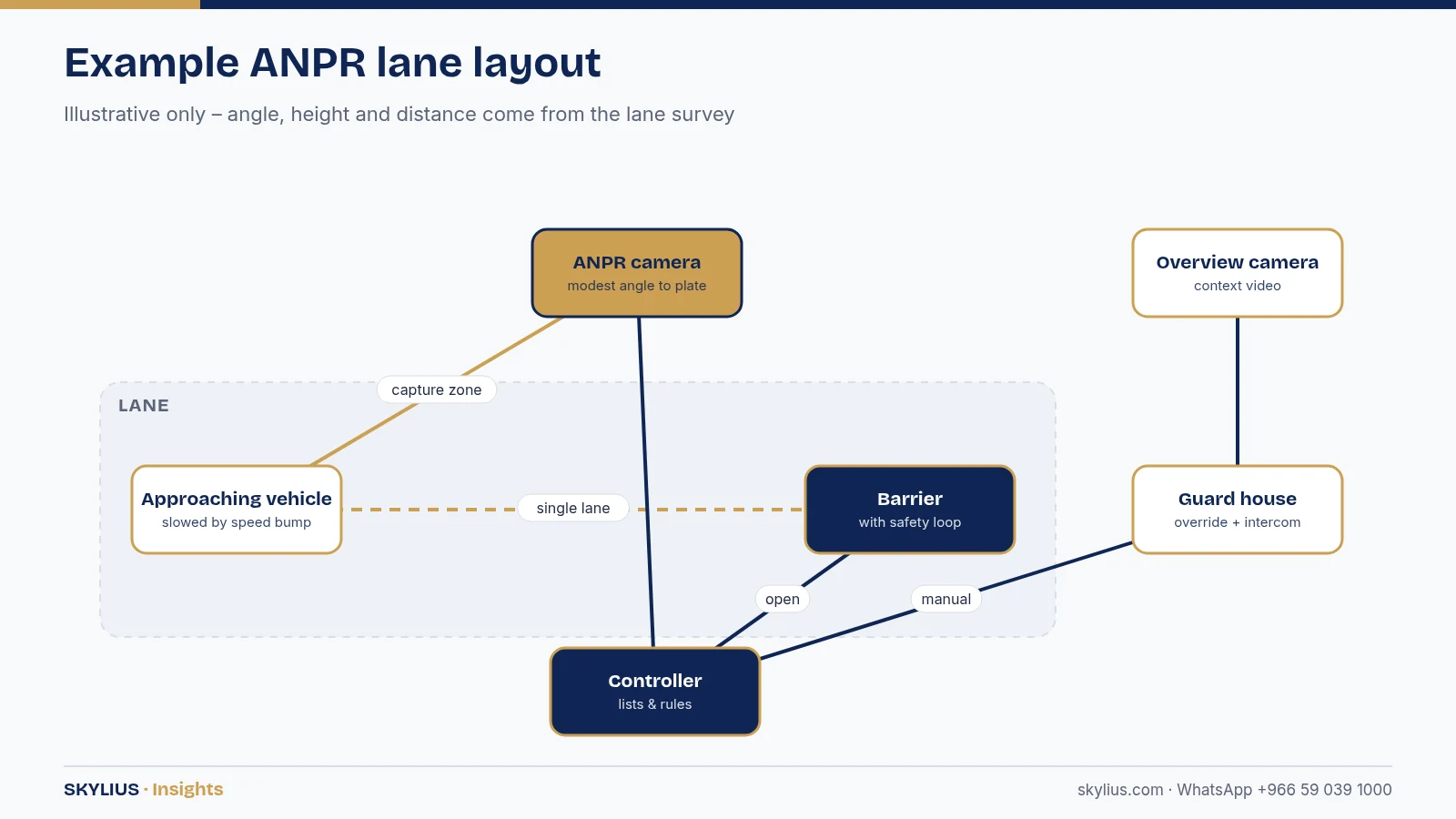
- Survey the lane – width, approach speed, slope, lighting and where vehicles stop.
- Choose the camera and lens for the capture distance.
- Design the barrier and loops – vehicle detection loops or sensors under the barrier to prevent it closing on a vehicle.
- Plan the network and power – cable, PoE switch, UPS, and links back to the guard house.
- Decide the software – edge or server-based, lists management, reports, integration.
- Configure lists and rules – residents, staff, visitors, time schedules.
- Test with real vehicles, day and night, then fine-tune.
Privacy and data
ANPR collects data that can be linked to people. Keep only what you need, restrict access to the records, set a sensible retention period, inform users with signage where appropriate, and follow Saudi Arabia’s Personal Data Protection Law (PDPL). For some sectors, authorities may also have specific surveillance requirements – check with the relevant authority.
Common mistakes to avoid
- Mounting a regular CCTV camera far away and expecting it to read plates.
- Placing the camera at too steep an angle to “fit” an existing pole.
- Letting vehicles approach fast with no speed control.
- Forgetting a safety loop under the barrier.
- No fallback process for unreadable plates or system faults.
- Leaving the ANPR system on an unsecured network.
Questions to ask an ANPR supplier
- Does the recognition engine support Saudi plates, including both Arabic and Latin characters, and how is it updated?
- Is recognition done on the camera or on a server, and what licences are needed for each lane?
- What capture distance and angle does the proposed lens and mounting position give?
- How are allow lists managed – by the guard, by the facility manager, by residents through an app, or by import from HR?
- What happens when the network or server is down? Can the lane still operate on cached lists?
- What reports are included – entries and exits per plate, visitor history, overstay alerts?
- How is the system secured – user roles, passwords, encrypted connections, firmware updates?
- What maintenance is included – cleaning the camera glass, checking alignment and infrared, testing loops and barriers?
Clear answers to these questions usually reveal the difference between a system that reads plates reliably for years and one that frustrates residents within weeks.
How Skylius helps
Skylius Holding designs and installs ANPR systems with barriers, loops, guard-house workstations and integration with CCTV and access control for compounds, car parks, warehouses and commercial buildings across Al Khobar, Dammam and the Eastern Province. We survey each lane and test with real vehicles before handover.
Plan your ANPR gate: visit our ANPR service or message us on WhatsApp +966 59 039 1000.
Frequently asked questions
What is the difference between ANPR and LPR?
They mean the same thing: automatic number plate recognition (ANPR) and licence plate recognition (LPR) both describe reading vehicle plates automatically.
Can ANPR read Saudi licence plates?
Yes, provided the recognition engine supports the Saudi plate format, which includes Arabic and Latin characters. Confirm local plate support before choosing a product.
Can a normal CCTV camera be used for ANPR?
Sometimes, with server-based software and careful placement, but dedicated ANPR cameras with fast shutter and infrared usually give more reliable results, especially at night.
Does ANPR work at night?
Yes. ANPR cameras use infrared illumination and settings designed to capture reflective plates in darkness.
How fast can vehicles be moving?
It depends on the camera and installation. At gates, vehicles are slowed or stopped by the barrier, which helps accuracy. Highway-speed reading needs specialised systems.
What happens if a plate cannot be read?
A good design includes a fallback: the guard can open the barrier manually, a card or intercom can be used, and the event is still recorded with an image.
Can ANPR be integrated with access control and CCTV?
Yes. ANPR events can open barriers through access controllers and be linked to recorded video, so you can search vehicles and view the related footage.
Is ANPR data subject to privacy rules?
Plate data can relate to individuals, so handle it as personal data under the PDPL, with limited access and defined retention.