

CCTV Installation Cost in Saudi Arabia: What Affects the Price
Quick answer
The cost of a CCTV installation in Saudi Arabia depends mainly on six things: the number of cameras, the camera types and resolution, the cabling distance and route, recording storage (NVR and hard disks), labour and access difficulty, and any integration with access control, ANPR or remote monitoring. Two quotes with the “same number of cameras” can differ a lot because they include different brands, storage periods, cable quality or warranty terms. The only reliable way to get a real price is a site survey followed by an itemised quotation that lists every component, so you can compare like with like. This guide explains each cost factor and gives you a checklist for comparing quotes.
Why there is no single “price per camera”
Many people ask for a price per camera. It is a reasonable starting question, but a camera is only one part of the system. A working CCTV installation also includes:
- Cameras (with brackets, junction boxes and sunshades where needed)
- Recording: an NVR (network video recorder) or video management software, plus hard disks
- Network: PoE switches, cabling, conduits or trunking, patch panels and sometimes fibre links
- Power and protection: UPS for the recorder and switches, surge protection for outdoor runs
- Display and access: monitors, a viewing workstation, mobile app setup
- Labour: survey, design, installation, configuration, testing and handover
- After-sales: warranty, support and an optional maintenance contract
A camera that is cheap to buy can become expensive if it needs a long cable run through a finished ceiling, a lift to reach a high mounting point, or a separate switch because the existing network has no free PoE ports.
The main cost factors explained
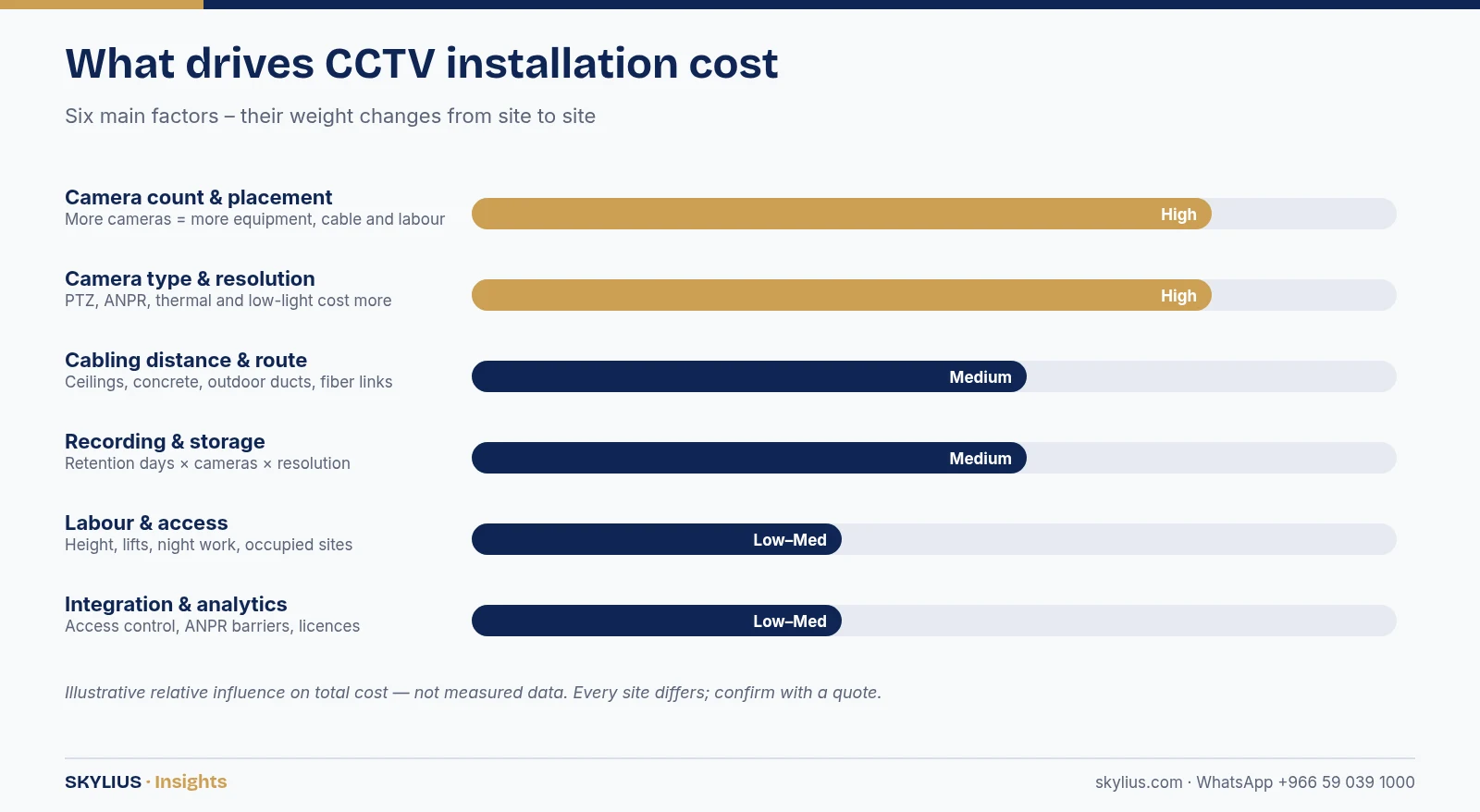
1. Number and placement of cameras
More cameras mean more equipment, more cable and more labour, but placement matters as much as count. A well-designed layout often uses fewer cameras because each one has a clear purpose: identifying faces at an entrance, reading plates at a gate, or giving an overview of a yard. A poor layout adds cameras to fix blind spots after the fact.
2. Camera type and resolution
Fixed turret, dome and bullet cameras are usually the most economical. PTZ, ANPR, thermal and high-end low-light cameras cost more because of their optics and processing. Higher resolution also increases cost indirectly: it needs more storage and network bandwidth. Read our guide to CCTV camera types to understand which type fits each location.
3. Cabling distance and installation route
Cabling is often underestimated. Standard copper Ethernet runs have a distance limit (commonly around 100 metres per run), so large sites may need intermediate switches or fibre links. The route also matters: running cable through an open warehouse roof is quicker than through finished office ceilings, concrete walls or underground ducts in a compound. Outdoor cable should be suitable for the environment and protected in conduit.
4. Recording and storage
Storage is driven by the number of cameras, resolution, compression (for example H.265), frame rate, motion versus continuous recording, and how many days you need to keep footage. Some sectors in Saudi Arabia have retention requirements set by authorities, so confirm what applies to you before sizing the hard disks. Longer retention means more or larger disks and sometimes a larger recorder.
5. Labour, access and working conditions
Labour cost depends on the height of mounting points, whether a scissor lift or scaffolding is needed, working hours (some sites only allow night or weekend work), and how far the site is from the installer. Occupied buildings, hospitals and live retail floors usually need more careful planning and phasing.
6. Integration and smart features
Linking CCTV to access control, ANPR barriers, alarm panels or a central monitoring room adds licences, configuration time and testing. Video analytics (line crossing, intrusion detection, people counting) may be included in the camera or require extra software licences.
Other factors to ask about
- Brand and warranty period – reputable brands with local support and longer warranties cost more but reduce risk.
- Network upgrades – existing switches may not have enough PoE power or ports.
- Power – a UPS keeps recording running during short outages.
- Cybersecurity setup – secure remote access, VLANs and password policies take time but are essential.
- Permits and approvals – some facilities need approvals or specific contractor classifications; check with the relevant authority.
Comparison: what changes between a basic and a complete quote
| Item | Basic quote often includes | Complete quote usually adds |
|---|---|---|
| Cameras | Camera units only | Brackets, junction boxes, sunshades, correct lenses per location |
| Recording | NVR with a small disk | Storage sized to your required retention period |
| Cabling | “Cabling included” (unspecified) | Cable type, estimated lengths, conduit/trunking, testing |
| Network | Uses existing switch | PoE budget check, dedicated switch/VLAN, UPS |
| Configuration | Basic setup | Recording schedules, analytics, user accounts, secure remote access |
| Handover | Verbal demo | As-built drawing, camera list, passwords handed over securely, training |
| After-sales | Short warranty | Clear warranty terms, response times, optional maintenance contract |
This table describes typical differences between quotes; it is not a price list.
Example project profiles (factor-based, not prices)
Rather than publish prices that would quickly become inaccurate, here is how the same factors play out in three common project profiles. Use them to understand where your budget will go.
Small shop or home (a handful of cameras)
Costs are driven mostly by the cameras and the recorder. Cabling is short, labour is usually completed quickly, and a compact NVR is enough. Spending a little more on good low-light cameras and a proper outdoor mount usually brings the biggest improvement.
Office or clinic (medium system)
Cabling through finished ceilings, coordination with the IT network, WDR cameras for glass entrances and integration with access control become important. Storage sizing and a UPS should be in the quote.
Warehouse, compound or factory (large system)
Long cable runs, fibre links between buildings, PTZ and ANPR cameras, lifts for high mounting points, and larger storage dominate. A structured design and a maintenance contract usually pay for themselves on sites of this size.
How to compare CCTV quotes fairly
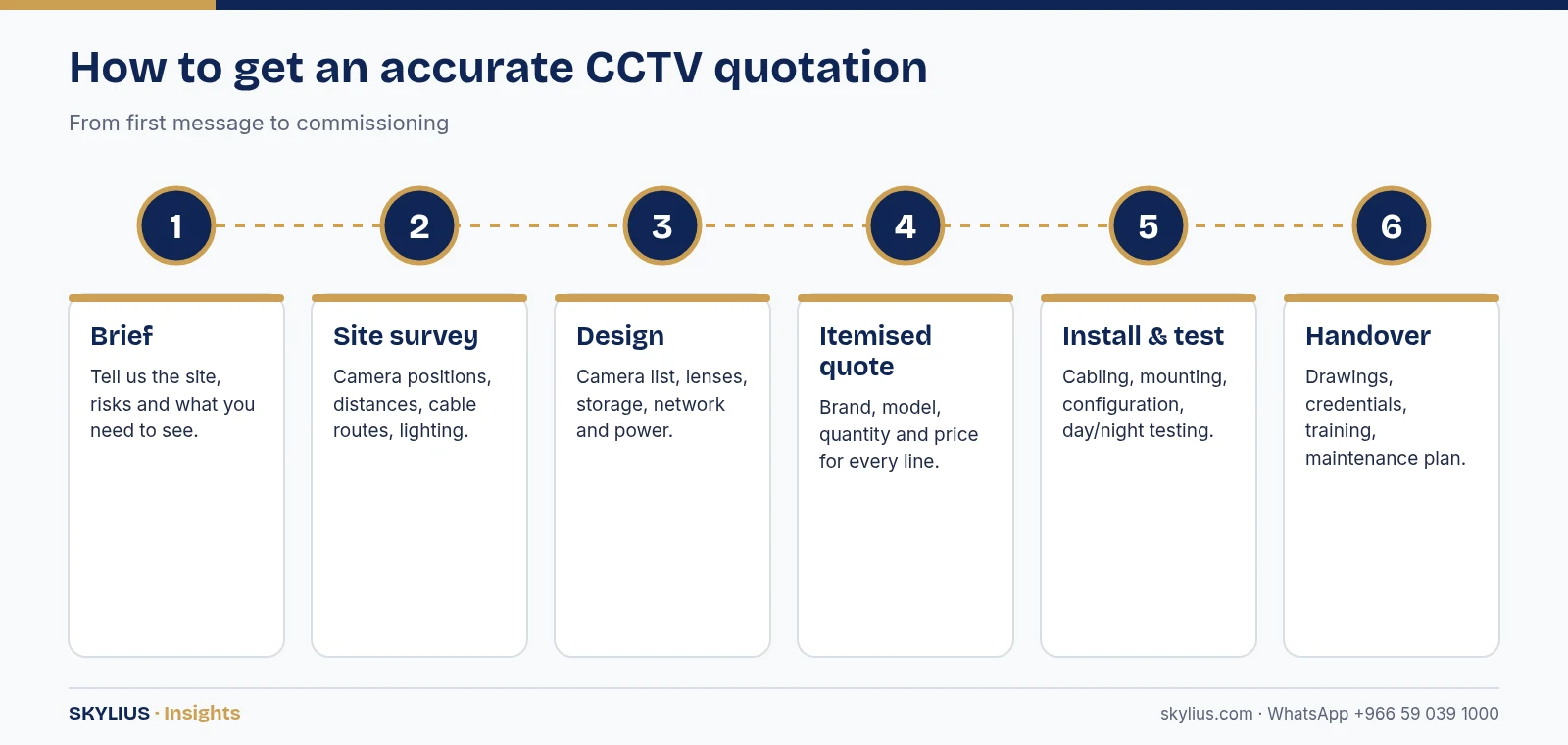
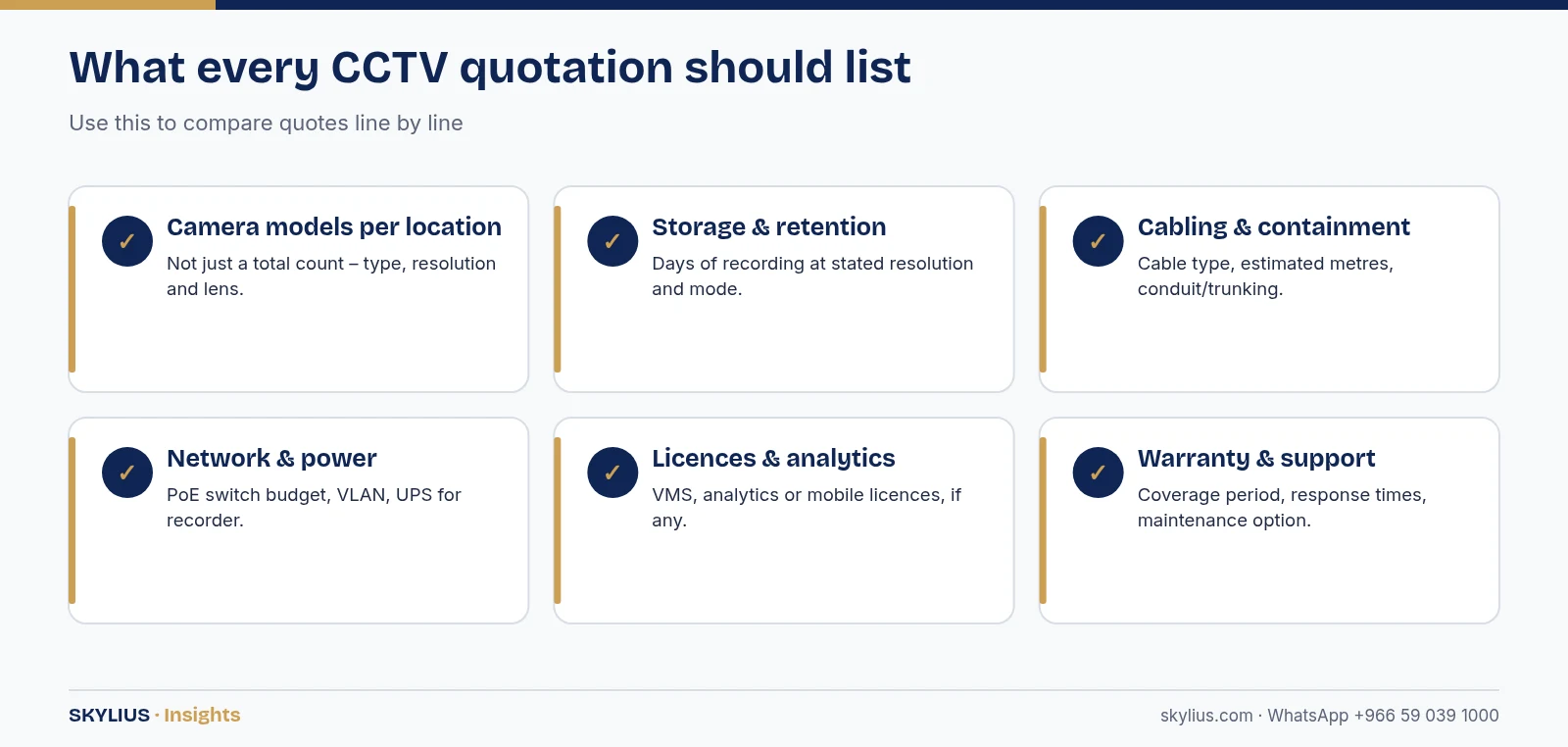
- Ask for an itemised quotation with brand, model, quantity and unit price for every line.
- Check camera models at each location, not just the total count.
- Confirm storage – how many days of recording at what resolution and recording mode.
- Confirm cabling – type, estimated metres and whether conduit is included.
- Check warranty and support – what is covered, for how long, and how fast someone responds.
- Ask about licences – VMS, analytics or mobile access may need paid licences.
- Ask what handover documents you will receive – drawings, IP list, credentials.
Ways to control CCTV cost without cutting quality
- Prioritise by risk. Cover entrances, cash points, gates and stock areas first; expand later.
- Choose the right lens, not just more megapixels. A correctly aimed 4MP camera can be more useful than a badly placed 8MP one.
- Plan for expansion. Leave spare ports on the switch and spare capacity on the recorder.
- Use motion or smart recording where appropriate to make storage go further.
- Reuse good existing cabling after testing it, rather than replacing everything.
- Bundle maintenance so cameras are cleaned, checked and updated regularly, which protects your investment.
How Skylius helps
Skylius Holding provides site surveys, camera layout design, supply, installation, network setup and maintenance for CCTV systems across Al Khobar, Dammam and the Eastern Province. Every quotation we send is itemised, so you can see exactly where your budget goes and compare it with other offers.
Request a free site survey: visit our CCTV installation service or message us on WhatsApp +966 59 039 1000.
Frequently asked questions
How much does it cost to install CCTV in Saudi Arabia?
It depends on the number and type of cameras, cabling distance, storage period, labour conditions and integration needs. Because these vary so much between sites, the most accurate answer comes from a site survey and an itemised quotation.
Why do CCTV quotes for the same number of cameras differ so much?
Quotes often differ in brand, resolution, lenses, storage capacity, cable quality, conduit, warranty and configuration work. Comparing itemised quotes line by line shows where the difference comes from.
Is it cheaper to use wireless cameras?
Wireless cameras can reduce cabling in some places, but they still need power, a reliable wireless link and good security. For most business installations, wired PoE cameras are more reliable and easier to maintain.
Does more storage cost a lot more?
Storage cost rises with the number of cameras, resolution and retention period. Using efficient compression and smart recording can reduce the storage needed. Confirm any sector retention requirements before deciding.
Can I reuse my existing cables when upgrading to IP cameras?
Sometimes. Existing network cable in good condition can often be reused after testing. Old coaxial cable may support HD-analog cameras or, with adapters, some IP setups. A survey will confirm what is reusable.
Should a CCTV quote include maintenance?
It is worth asking for a maintenance option. Regular cleaning, health checks, firmware updates and storage checks keep the system working when you need footage.
Do I need approvals before installing CCTV?
Some facility types in Saudi Arabia have specific surveillance requirements or approval processes. Check the current rules with the relevant authority and work with a qualified contractor.
How long does a CCTV installation take?
Small systems can often be completed quickly, while large sites with long cable runs and integration take longer. Your contractor should give you a schedule after the survey.