
Structured Cabling Cost in Saudi Arabia: Cat6 vs Cat6A vs Fiber
Quick answer
Cat6 copper cabling is the common, economical choice for office desks, phones, access points and CCTV over typical distances; Cat6A supports higher speeds (up to 10 Gb/s over the full standard channel length) and higher-power PoE devices, and is often chosen for new buildings that want headroom; fiber optic is used for backbones between racks, floors and buildings and for distances beyond copper’s limit. Most well-designed networks use copper to the outlets and fiber for the backbone. The cost of a structured cabling project depends on the number of points, cable category, route difficulty, containment (trays, trunking, conduit), rack and patching hardware, testing and certification, and labour conditions. Ask for an itemised quote with a test report at handover.
What is structured cabling?
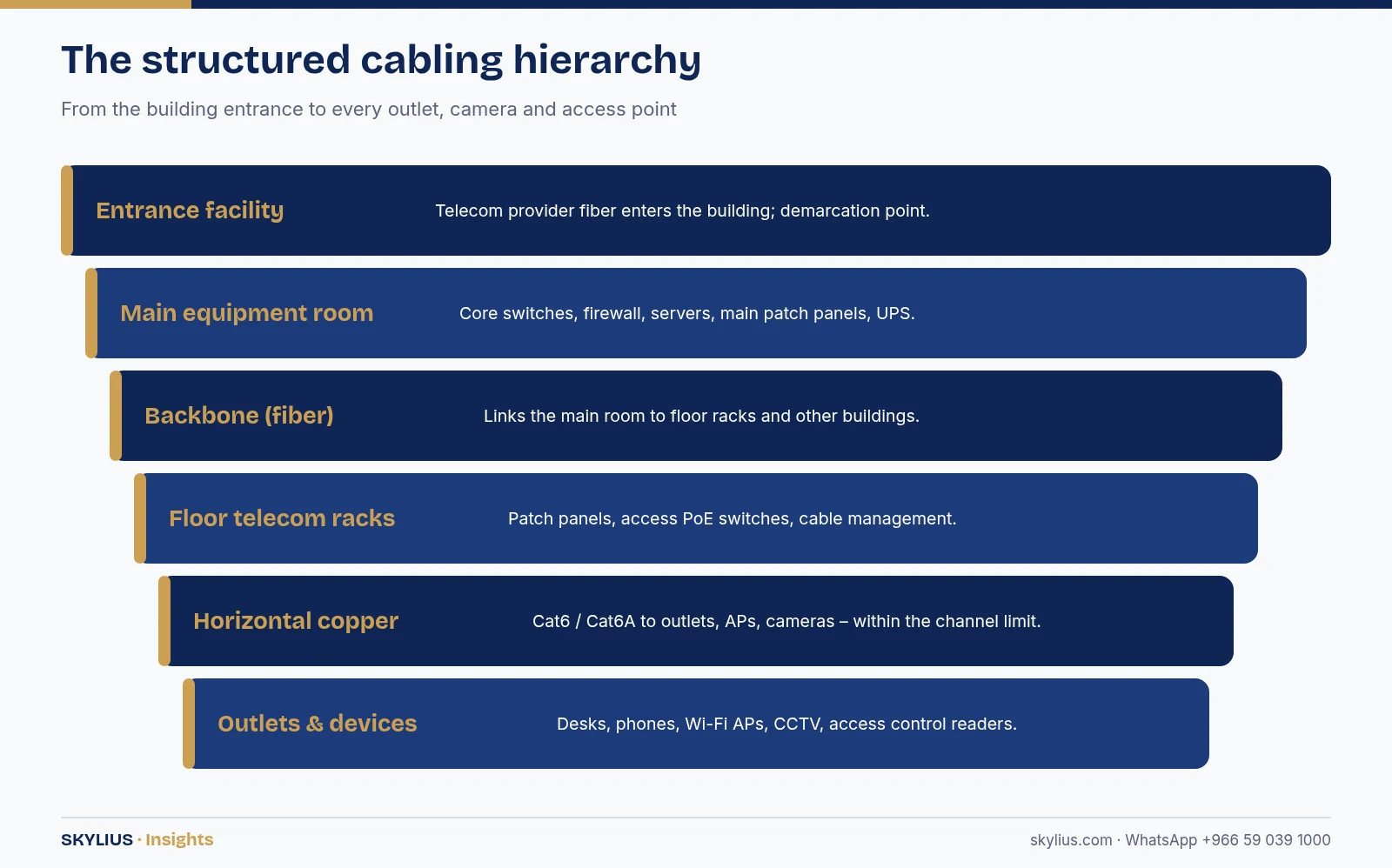
Structured cabling is an organised, standards-based way of wiring a building for data, voice, Wi-Fi, CCTV, access control and other systems. Instead of ad-hoc cables run from device to device, everything follows a planned hierarchy:
- Entrance facility – where external services (fiber from the telecom provider) enter the building.
- Main equipment room / server room – core switches, servers, firewall and main patch panels.
- Backbone cabling – usually fiber, linking the main room to floor or building telecom rooms.
- Telecom rooms / floor racks – patch panels and access switches serving one floor or area.
- Horizontal cabling – copper cables from floor racks to each outlet, access point or camera.
- Work-area outlets – the wall or floor sockets users plug into.
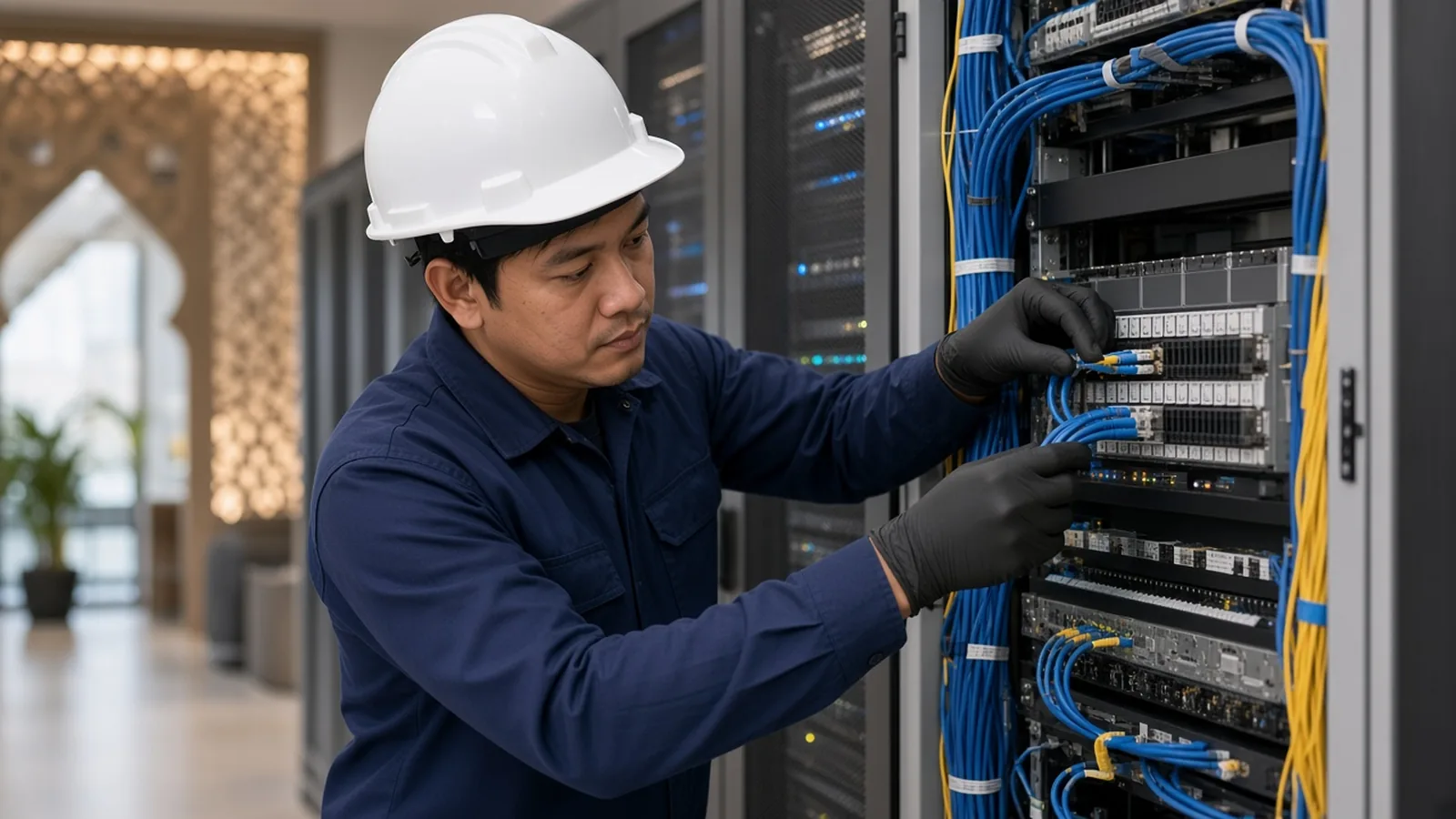
Every cable is labelled, terminated on patch panels and tested, so changes and fault-finding are quick and tidy.
Cat6 vs Cat6A vs fiber
Cat6
Cat6 is the workhorse of most offices. It supports Gigabit Ethernet comfortably across the standard channel length and 10 Gb/s over shorter distances. It is easier to handle than Cat6A, takes less space in trays, and is generally more economical.
Cat6A
Cat6A is designed for 10 Gb/s over the full standard channel length and handles heat from high-power PoE bundles better. It is thicker and stiffer, so it needs more containment space and careful installation. It suits new buildings, Wi-Fi 6/6E/7 access points, high-power PoE devices and organisations planning to keep the cabling for many years.
Fiber optic
Fiber carries data as light. It supports long distances and very high speeds and is immune to electrical interference. Multimode fiber is typically used inside buildings and campuses; single-mode fiber is used for longer distances. Fiber is the standard choice for backbones and links between buildings, such as across a compound or warehouse site.
Comparison table
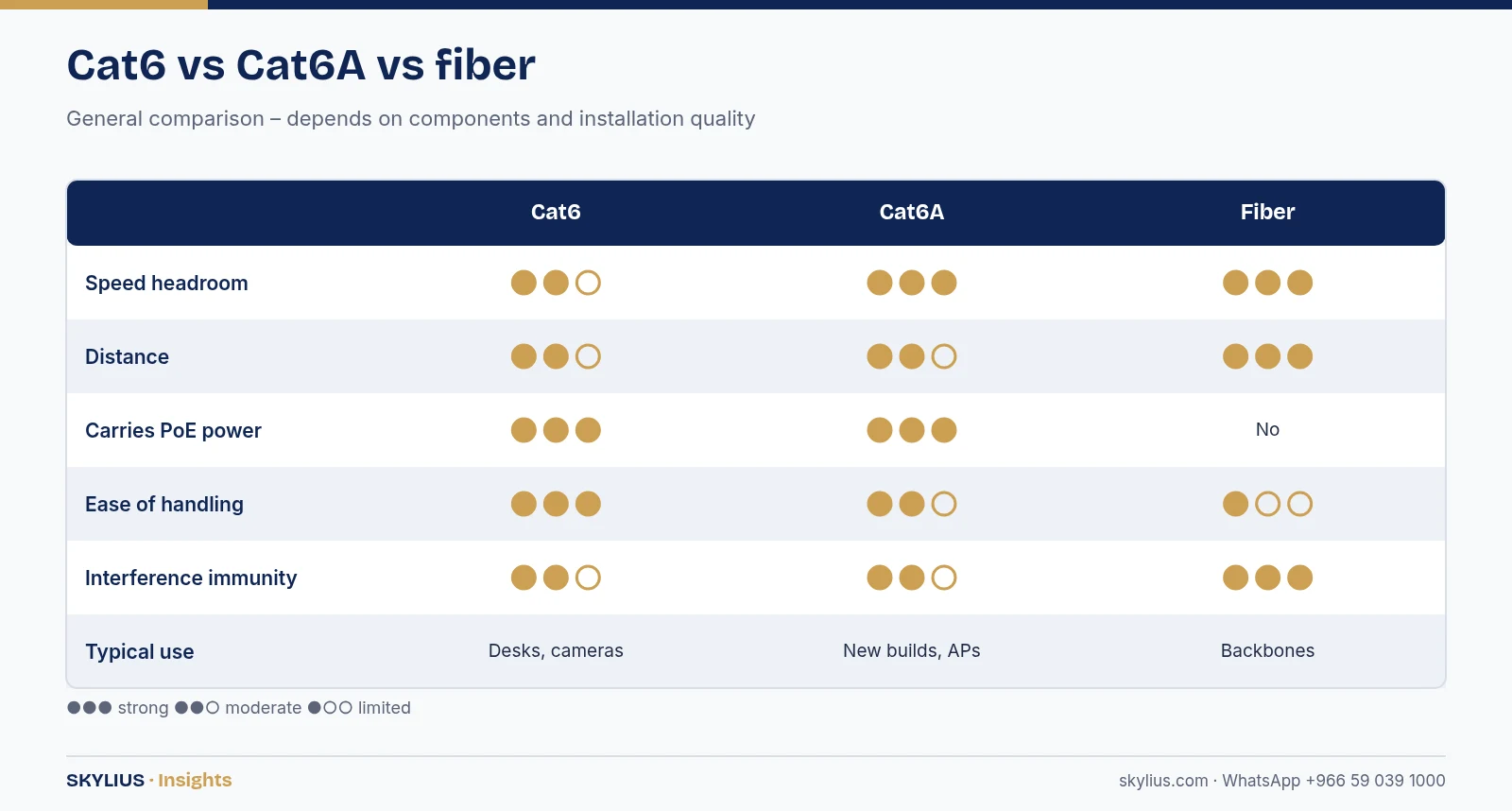
| Feature | Cat6 | Cat6A | Fiber (multimode / single-mode) |
|---|---|---|---|
| Typical use | Desks, phones, cameras, APs | New builds, high-speed APs, high-power PoE | Backbones, inter-building links |
| Speed headroom | 1 Gb/s (10 Gb/s short runs) | 10 Gb/s full channel | 10 Gb/s and beyond |
| Distance per copper channel | Standard limit (~100 m) | Standard limit (~100 m) | Much longer (depends on type) |
| Carries PoE power | Yes | Yes, better heat handling | No (needs media converter/power) |
| Cable size / handling | Thinner, easier | Thicker, needs more space | Thin but needs specialist termination |
| Relative material cost | Lower | Medium | Medium–High (incl. termination) |
| Interference immunity | Good | Better | Immune to EMI |
General comparison only. Exact performance depends on the components, installation quality and applicable standard.
What affects structured cabling cost
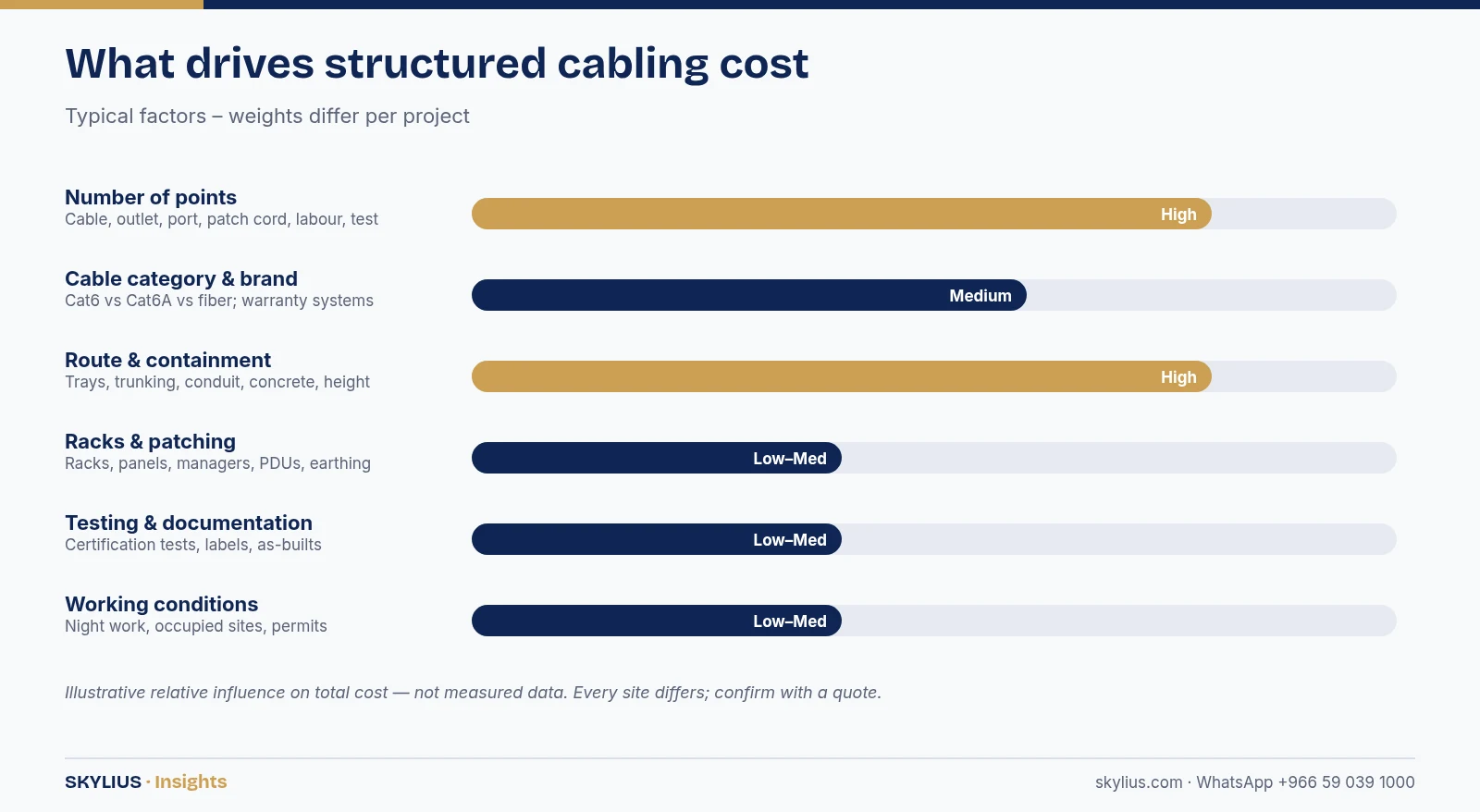
Number of points
Each data point includes cable, an outlet, a patch panel port, a patch cord, labour to install and terminate it, and testing. More points usually mean a lower cost per point, but total cost rises.
Cable category and brand
Cat6A and fiber cost more than Cat6 in materials and installation time. Branded end-to-end systems with manufacturer warranties cost more than mixed components but give a documented performance guarantee.
Route and containment
Open ceilings, raised floors and existing trays are quicker. Concrete walls, finished ceilings, outdoor runs, long warehouse spans and underground ducts take longer and may need new trays, trunking or conduits.
Racks and active equipment
Racks, patch panels, cable managers, PDUs and earthing are part of passive cabling. Switches, firewalls and access points are usually quoted separately – check what is included.
Testing and documentation
Every link should be tested with a certification tester and documented. Testing takes time but proves the installation performs as designed. Ask for test results and as-built drawings.
Working conditions
Night work, occupied offices, height, permits and site access all affect labour time.
Use-case recommendations
Small office
Cat6 to every desk and access point, a wall-mounted rack with patch panels, and spare points for printers, phones and future growth.
New corporate office
Cat6A horizontal cabling for headroom, fiber backbone between floors, dedicated points for Wi-Fi access points in the ceiling, and a properly ventilated server room.
Warehouse or factory
Cat6 or Cat6A for cameras and access points with industrial-grade outlets where needed, fiber between distant racks or buildings, and attention to containment in high, open spaces.
Villa compound or campus
Fiber between buildings and the guard house, copper inside each building, and outdoor-rated cable and conduits for cameras and gates.
How to compare cabling quotes
- Is the cable category and brand stated for every link?
- Are outlets, patch panels, patch cords and racks included?
- Is containment (trays, trunking, conduit) included and specified?
- Is every link tested and is a test report provided?
- Are labelling and as-built drawings included?
- What warranty applies to the installation?
- Are active devices (switches, access points) included or separate?
How Skylius helps
Skylius Holding designs and installs Cat6, Cat6A and fiber structured cabling, racks and server rooms for offices, warehouses, clinics and compounds across Al Khobar, Dammam and the Eastern Province. Every project is labelled, tested and documented, and we can deliver the network, Wi-Fi, CCTV and access control that run on it.
Request a cabling survey: visit our structured cabling service or message us on WhatsApp +966 59 039 1000.
Frequently asked questions
Should I choose Cat6 or Cat6A for a new office?
Cat6 suits most current office needs. Cat6A gives more headroom for 10 Gb/s, newer Wi-Fi access points and high-power PoE, so many new buildings choose it when the budget allows.
When do I need fiber optic cabling?
Fiber is used for backbones between racks, floors and buildings, and wherever distances exceed the copper channel limit or electrical interference is a concern.
How far can an Ethernet cable run?
Standard copper Ethernet channels are designed for about 100 metres including patch cords. Longer distances need a switch in between or a fiber link.
What is included in the cost per network point?
Typically the cable, outlet, patch panel port, patch cord, installation, termination, labelling and testing. Confirm with each supplier as definitions vary.
Can I reuse existing network cabling?
Often, if it is a suitable category and passes testing. Old or untested cable may cause intermittent faults and is worth replacing in key areas.
Why is cable testing important?
Certification testing proves each link meets its category performance and gives you documentation for warranty and future troubleshooting.
Is Cat7 or Cat8 better for offices?
These are less common for typical office horizontal cabling. Cat6 or Cat6A with fiber backbones meets most business needs; ask your designer about specific requirements.
How long does a structured cabling project take?
It depends on the number of points, route complexity and site access. A survey allows the contractor to give a realistic schedule.